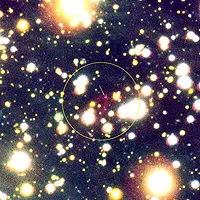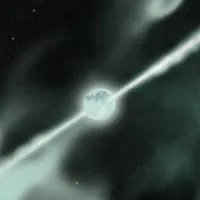
In a series of observations over a four-month period, NASA's Swift satellite has challenged some fundamental ideas of astronomers about gamma-ray bursts or GRBs (Gamma Ray Burst). GRBs are the explosive deaths of very massive stars that eject in seconds as much energy as the Sun radiates in 10 billion years of life.
Via EurekAlert
When GRBs encounter interstellar gas, the resulting collision generates an intense afterglow that can radiate brightly in X-rays and at other wavelengths for several weeks. Swift has monitored, however, a GRB whose afterglow remained visible for more than 125 days in the XRT, the satellite's X-Ray Telescope.
The Burst Alert Telescope (BAT) detected the GRB in the constellation of Pictor on July 29, 2006. The XRT captured the GRB (called GRB 060729 for its detection date) 124 seconds after the BAT detection. Normally, the XRT monitors afterglows for one or two weeks until they become invisible. But for the July 29 explosion the afterglow started so bright and faded so slowly that the XRT was able to monitor it regularly for months and the instrument was able to detect it until late November. The distance of the explosion (much closer than other GRBs) was a factor in the instrument's ability for such extensive monitoring.
The slow fading of the X-ray afterglows has several important ramifications for the understanding of GRBs. A large amount of energy injection is required from what we normally see in explosions and it might require a continuous contribution from the center that produced it.
One possibility is that the central engine of the GRB is a magnetar, a neutron star with a powerful magnetic field. The field acts as a brake, forcing the star to slow its rotation rate. The energy from this rotation can be converted into magnetic energy that is continuously injected into the initial explosion.
An explosion observed on January 10 of this year also suggests that magnetars are what power some GRBs. The explosion GRB 070110 generated an afterglow that remained almost constant in brightness for five hours and then faded very rapidly. In another paper submitted to Astrophysical Journal, an international group led by Eleonora Troja of INAF-IASF in Palermo, Italy, proposes that magnetars are the best explanation for these observations.
The results of the observations will be published in an upcoming issue of Astrophysical Journal.