A mystery that has lasted a decade has been solved using data from ESA's X-ray observatory, XMM-Newton.
The brightest member of the "Magnificent Seven" has been found pulsating with a period of seven seconds.
Via ESA
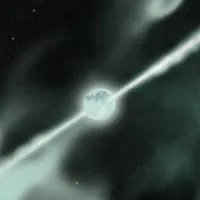
The Magnificent Seven are a collection of young neutron stars, which are the remnants of massive star explosions. They contain about 1.4 times the mass of the Sun but are compressed by gravity into ultra-dense spheres only 10 to 15 kilometers in diameter. A Euro coin made of the material of a neutron star would weigh more than the entire population of the planet. What separates the Magnificent Seven from the 1700 neutron stars seen as radio pulsars is that they are not detected at radio frequencies but their surfaces are hot enough to emit X-rays.
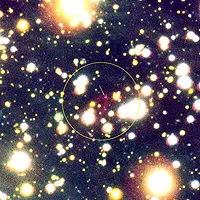
The brightest member, RXJ1856, has been a mystery to astronomers since it was discovered a decade ago because despite being so bright, no pulsation or its rotation rate has been detected.
This has changed thanks to the work of Andrea Tiengo and Sandro Merenghetti, from the National Institute of Astrophysics in Milan, Italy.
Using XMM data, they looked for signs of pulsations and found a repetitive pulse every 7 seconds after an observation of the source made in October 2006. They checked other archive data and confirmed the pulsation recorded in five other observations between 2002 and 2006.
The pulsations of RXJ1856 have a very low amplitude, which explains why they were not seen before.
After the Hubble Space Telescope had estimated a distance of 500 light-years to the object, its radius was estimated at less than 10 kilometers. This was taken as possible evidence that it was an even more exotic object, a quark star.
According to Tiengo, the new finding does not rule out this previous hypothesis, but the pulsations show that the object is also consistent with neutron star models.
The discoveries will appear in the March 10 edition of The Astrophysical Journal, (657: L101–L104, March 10, 2007), in an article by Andrea Tiengo and Sandro Mereghetti (INAF–Istituto di Astrofisica Spaziale e Fisica Cosmica, Milan, Italy) titled: "XMM-NEWTON discovery of 7s pulsations in the isolated neutron star RX J1856.5-3754."
More on this:
Quark stars, in Axxón
Stars, in Página/12