A "failed" type of star, the so-called brown dwarf, emits flashes of radiation at intervals that are thousands of times brighter than those emitted by the Sun.
Paul Rincon
BBC Science, Preston
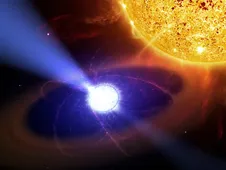
Brown dwarfs are behaving like completely different and exotic cosmic bodies, the so-called pulsars.
A pulsar -a term derived from the English acronym for pulsating star- is a rotating neutron star that emits signals of radiation at regular, short intervals.
When its beam passes over Earth, like the light from a lighthouse, astronomers can detect the pulse of radiation.
Pulsars are created when a massive star explodes in a supernova and its core collapses into a neutron star, which begins to rotate rapidly.
Brown dwarfs, on the other hand, are "failed stars," lacking sufficient mass to start nuclear fusion in their cores.
Greg Hallinan of the National University of Ireland, Galway, and his colleagues used the Very Large Array radio telescope in New Mexico to observe a moderately hot, very fast-spinning brown dwarf called TVLM 513-46546.
A 40-year problem
Every two hours they could observe a bright flash from the brown dwarf.
All planets with a magnetic field, including Earth, emit bright radiation from their polar regions.
Brown dwarfs are thought to generate their own emission in a manner similar to that of pulsars. But instead, their emission is much brighter than that of planets.
The radio waves are produced above the celestial body's magnetic poles.
The radio emission requires these brown dwarfs to possess magnetic fields as powerful as those detected in magnetically active stars.
The periodic pulse detected above brown dwarfs is very similar to that observed in pulsars.
But the whole system is on a much smaller and slower scale, and that makes it easier for astronomers to decipher what is happening.
A missing link?
How pulsars produce their radiation has been an unsolved problem for nearly 40 years in astrophysics.
This is because we have little knowledge of what happens to the hot, electrified gas or plasma, and how it behaves under the extreme conditions present in a pulsar.
Brown dwarfs now belong to a "second class" of stellar objects known to produce persistent levels of extremely bright and "coherent" radiation.
However, in their case, the conditions at the radiation source and the emission mechanism are fairly well understood.
For some time, it has been studied whether similarities exist between this type of emission and that of pulsars.
Studies of TVLM 513-46546 could provide the first direct evidence of the link.
Hallinan said: "Our research shows that these objects can be fascinating and dynamic systems, and they could be the key to unraveling that age-old mystery of how pulsars emit their radiation."
"It seems that brown dwarfs are the missing link between the radioactive emissions we can observe on Jupiter and those we see in pulsars," he added.
The astrophysicist from the National University of Ireland presented the details of his work at the National Astronomy Meeting of the Royal Astronomical Society, in Preston.