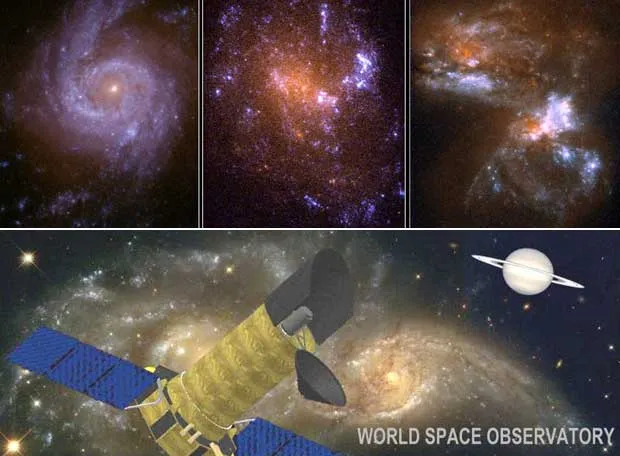
The Virtual Observatory (VO) interconnects the archives of telescopes from all over the planet and in space, and puts them within reach of any astronomer with Internet access. Thus, just a few clicks are enough to open windows to hundreds of thousands of astronomical objects, seen in all wavelengths. Revolutionary.
Via ESA and Noticias.info
The VO is one of the tools that is most changing the way of working in astrophysics, and at the European Space Astronomy Centre (ESAC), of ESA, in Madrid, they teach how to use it.
You are an astronomer and you want to know what data exists, taken with any telescope, about our neighboring galaxy Andromeda. You have two options. You can search all the scientific literature and then request the data from the archives of each of the telescopes with which they were obtained; or you can consult the Virtual Observatory, VO. Needless to say, which will be faster and more exhaustive.
The VO is an initiative of the international astrophysics community, structured partly geographically. In Europe, eight organizations - among which is the European Space Agency (ESA) - have created the EURO-VO project, which in turn is a member of the International Virtual Observatory Alliance (IVOA) along with 14 other organizations from Australia, North America and Asia.
Lecture during the workshop at ESAC
Lecture during the workshop at ESAC
ESAC, in Villafranca del Castillo (Madrid), is the ESA center responsible for the Virtual Observatory. During last week it hosted the conference “Astronomic Spectroscopy & Virtual Observatory Workshop” –Astronomical Spectroscopy and Virtual Observatory-, which was attended by about 125 astrophysicists from all over Europe.
As explained by Pedro Osuna, Technical Coordinator of the ESA Virtual Observatory and co-organizer of the workshop at ESAC, “the Virtual Observatory is something new, we still have to explain to the astrophysics community what can be done with it, what possibilities it has. And, at the same time, we want to know the needs of astrophysicists in order to develop the appropriate tools in the VO”.
Easier, faster
The Virtual Observatory is indeed so new that it is still under construction. Engineers in many of the participating organizations have developed tools already applicable to the VO and therefore available to astrophysicists. Now it is necessary for them to know about them. The workshop at ESAC was dedicated to applications for spectroscopy – one of the astronomical techniques with which the most information is extracted from celestial objects -.
Osuna gives an example: “Astronomers need to know how much energy a star emits at each wavelength. For that they must consult data from telescopes that observe in each of the wavelengths, superimpose them, “paste” them, and do the unit conversion and other tedious operations. But with one of the tools we have developed at ESAC, both the search and the superimposition, unit conversion, etc. are done automatically within the Virtual Observatory environment”.
The fact that the attendees of the meeting demanded more tools of this type, useful for the scientific analysis of the data, is already an indication of its success. Another are the messages sent to the organizers right after the workshop ended: “(...) I have discovered the variety of tools I have at my disposal for my research. (...) I will certainly do many tests with the VO tools, and I will certainly use them. In other words, my daily work will change thanks to this workshop”, wrote one of the attendees.