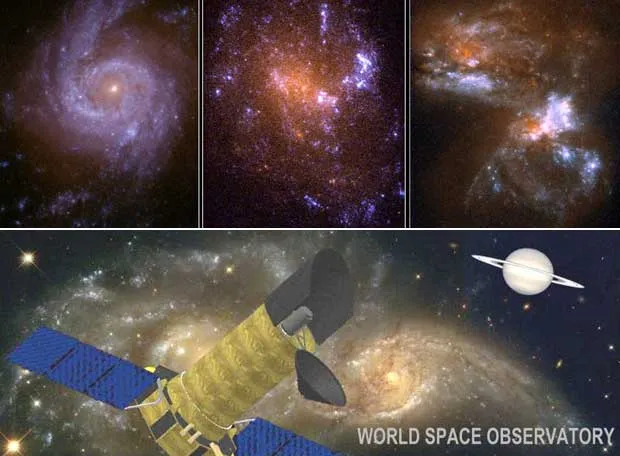
Scientists using the AKARI infrared satellite, launched in 2006, are publishing their initial results at the annual meeting of the National Astronomical Society of Japan. The results show the intimate relationship between the death of stars, which releases material into the interstellar medium (the collection of dust and gas between stars and galaxies) and the birth of new stars.
Via EurekAlert and ESA Int
New results will be presented at the conference, especially in five points:
-Evidence of three generations of continuous star formation in a nebula (IC4954/4955, in the constellation Vulpecula, about 6500 light-years away), each one dependent on the preceding generation, which will allow a detailed study of the process in which they themselves form.
-The first infrared observations of a supernova remnant (Bo404-72.3) in our galactic neighborhood, the Small Magellanic Cloud, which will allow the study of how material expelled in supernova events interacts with the surrounding interstellar medium and provides it with heavy elements formed in stellar cores.
-First observations of red giants in their primary stages of evolution losing large amounts of material to the interstellar medium. This mechanism was theoretically predicted as the means by which such stars that are too small for a supernova event (like our Sun) end their lives. Previous observations had seen this process in red giants in their final stages, but AKARI was able to achieve observations of it in young stars and provides evidence that this sporadic process that stars go through once they enter the red giant period.
-Processes in the centers of an active galactic nucleus. These are compact areas in the center of galaxies, very bright. They are thought to contain massive black holes that drive these processes. AKARI has looked inside the center of such a galaxy, invisible to other telescopes due to a thick interstellar medium, and has seen the signature of carbon monoxide in the vicinity of the central black hole.
-Deep cosmological study, sensitive to the characteristic emission of organic material into the medium by distant star-forming galaxies. Previous studies showed that the universe went through a period of intense star formation 6 billion years ago. The new study, ten times larger, found evidence that this would have occurred even earlier than stipulated.
More information on the Institute of Space and Astronautical Science page