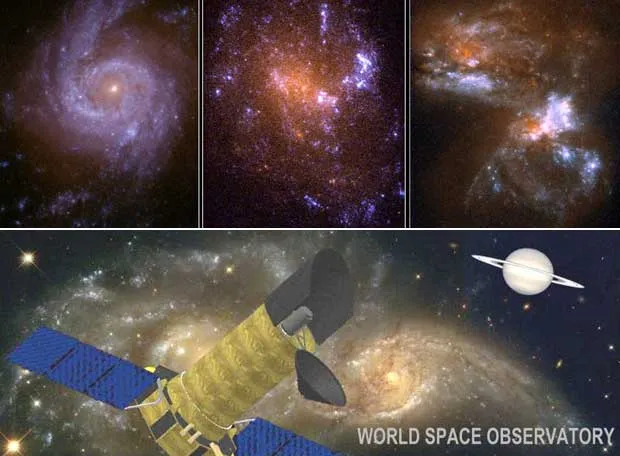
The observatory, which will see the sky in ultraviolet, will be placed into orbit in 2012
Via El País
ALICIA RIVERA
Spain and Russia have signed an agreement this week to develop a space ultraviolet telescope that could be placed into orbit in 2012. The project, called the World Space Observatory (WSO, in its English acronym), comes to fill a gap in international astronomy for which the major space agencies have no plans to launch new missions. The WSO is an idea proposed a few years ago around which feasibility studies have been carried out in several countries and which is now taking shape with the first formal agreement of the project.
Germany, Italy, China and South Africa are negotiating their participation in the mission and their formal entry is expected shortly. The total cost of the telescope will be around 300 million euros, according to sources from the Center for Industrial Technological Development (CDTI). This agency of the Ministry of Industry directs space activity and has signed the agreement for the mission with the Russian Space Agency, Roscosmos. Of that total amount, about 100 million would be for the launch and operation of the satellite, about 150 for making the space platform and the telescope, and another 50 for instrumentation.
Spain's contribution to the construction of the satellite will be around 15%, to which will be added later the funding for the Spanish scientific community to develop WSO instruments, under the National Space Program. The WSO will have a mirror 1.7 meters in diameter, so it will be a space observatory of considerable size, and will have both a camera and spectrometry equipment to analyze the light from celestial bodies.
Currently there is only one detector in orbit in the ultraviolet range (the American Fuse, dedicated to spectrometry). The Hubble Space Telescope has also observed some in ultraviolet, but it is now focused on infrared. Since the most fruitful ultraviolet telescope that ever existed, the IUE, stopped working in 1996, there has been no specific instrument in space for this wavelength that is comparable, and the space agencies have no such mission in their portfolio. For this reason, Spain, Russia and the other countries have seen the opportunity in the WSO to fill that ultraviolet gap by developing an advanced instrument.
Celestial bodies and phenomena emit in all wavelengths of the electromagnetic spectrum, from radio and microwaves to energetic gamma rays, including the visible light that is the only one human eyes see. But the Earth's atmosphere absorbs a large part of the radiation: fortunately for living beings, gamma radiation and X-rays do not reach the planet's surface, nor does ultraviolet - nor almost infrared either. And, since astronomers need to see the sky across the entire spectrum, they have to place telescopes in space when dealing with phenomena that emit only, or preferably, in the wavelengths intercepted by the air.
Hot gas clouds in the galaxy or giant stars are obvious targets for the WSO, as are many other high-temperature phenomena. Scientists even want to witness in stars near Earth the activity observed on the Sun.
In the space field, it is considered that a telescope like the WSO, even though it represents a significant technological challenge, can be undertaken by national programs or in collaborations of several countries, without the intervention of the major agencies being essential.
For Spain, in addition to the interest of the scientific community (with great specialists trained and trained on the historic IUE), the new observatory attracts the space industry, which will be in charge of the so-called ground segment (the control center and the satellite operation systems). It will also contribute some telescope equipment and electronic and data processing systems.