Of all the stars in the galaxy, two classes, known as hydrogen-deficient (HdC) and R Coronae Borealis (RCB), are extremely rare.
Via UniverseToday
Only a few dozen have been discovered in the Milky Way. And unlike most stars, they have almost no hydrogen. Instead, they possess an abnormally high amount of rare oxygen isotopes.
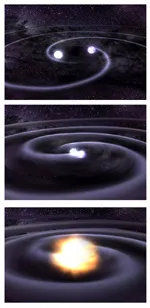
What could be the origin of these strange objects? An international team of astronomers thinks that the collision of white dwarfs could be the answer.
A white dwarf is the fate that awaits our sun. After using up its hydrogen fuel, the star becomes a red giant. But when its helium runs out, it does not have the mass to continue the chain to carbon. Instead, it collapses into a small object, called a white dwarf.
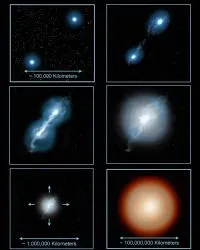
But if two white dwarfs collide, they could create a new gas cloud hot enough to start nuclear reactions again, which generates nuclear fusion in the dwarfs, briefly turning them into a supergiant.
The discovery of abnormal amounts of oxygen-18 is based on near-infrared observations from the Chilean Gemini South telescope.
The team performed simulated nuclear reactions to see what would happen if two white dwarfs collided. According to Geoffrey Clayton, the conditions must be just right for the formation of the oxygen-18 observed in these stars. In the fusion process, when the nuclear reactions take place, the temperature was neither too hot nor too cold, but just right for the production of large amounts of this isotope.
An alternative theory, originally proposed by Icko Iben (University of Illinois), is that stars rich in oxygen-18 could have been formed when a star on the verge of becoming a white dwarf has a thermonuclear eruption near its surface. This inflates the star to supergiant size and cools its outer atmosphere.
The findings were presented at the 209th Meeting of the American Astronomical Society in Seattle by a team consisting of: Dr. Geoffrey C. Clayton (Louisiana State University, Baton Rouge, LA), Dr. Thomas R. Geballe (Gemini Observatory, Hilo, HI), Dr. Falk Herwig (Keele University, UK) and Dr. Christopher Fryer (Los Alamos National Laboratory, Los Alamos, NM), and Dr. Martin Asplund (Mount Stromlo Observatory, Australia).
Original Source: Gemini News Release
Translated from UniverseToday and expanded with data from the original source.