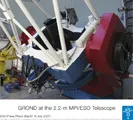
The VERITAS telescope system, costing about $20 million, at the Fred Lawrence Whipple Observatory in Tucson, does not look like a normal telescope. It is made of four 12-meter reflectors that look like satellite dishes. The reflectors are covered with mirrors that send light to cameras at the front of each dish. Each camera is about 7 feet and contains 500 pixels. The system is based on techniques by researchers from the University of Iowa Richard Lamb and David Carter-Lewis.
Via EurekAlert
VERITAS is an acronym for Very Energetic Radiation Imaging Telescope Array System, or in Spanish, Sistema de telescopios de imagen para radiación muy energética. It will be used, as explained by Frank Krennrich, professor of physics and astronomer at Iowa, in the search for gamma rays in space.
Although they are very energetic, gamma rays cannot penetrate Earth's atmosphere. But when they strike it, showers of electrons and positrons are created that produce a blue light known as Cherenkov Radiation, which moves very fast and is not very bright, thus requiring a very sensitive instrument to detect it.
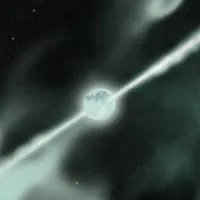
Astrophysicists know that gamma rays are produced by supermassive black holes, supernova remnants, pulsars, and of course, there are the so-called GRBs or gamma-ray bursts. The Crab Nebula is a source of gamma rays.
Published in:
The First VERITAS Telescope Astropart.Phys. 25 (2006) 391-401