A new instrument has seen first light at the La Silla Observatory of ESO, in Chile. GROND takes images in seven colors simultaneously and will be used mainly to determine distances of gamma-ray bursts.
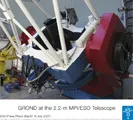
An image of the instrument and a series of images of the quasar PKS 1251 with 7 filters - (c) ESO
Taking images in different filters simultaneously is important for the study of many astrophysical sources and, in particular, of variable sources like close binaries or active galactic nuclei. But it is more crucial in the follow-up of gamma-ray bursts (GRBs). GRBs are short bursts of energetic gamma rays that last from less than a second to several minutes. They release a tremendous amount of energy in that short span, making them powerful events.
Gamma rays are invisible to our eyes and are discovered by orbital telescopes. After releasing their intense high-energy radiation, they become detectable for a fleeting moment in the optical and near-infrared spectrum. This "afterglow" fades quickly, making its detailed analysis possible for only a few hours after detection. The analyses are important for determining their distances and brightnesses.
A first determination of their distance can be made by taking images through different filters using what is known as photometric redshift. As a typical GRB afterglow becomes 15 times fainter after 10 minutes, and about 200 times after an hour, it is important to observe the object with as many filters as possible.
"To determine the distance of very distant objects as precisely as possible, we have decided to use four different filters in the optical and three in the near-infrared," says Jochen Greiner, who leads the instrument's development.
GROND takes images of the same region of the sky in 7 different filters. The field of view in the near-infrared is 1/7th the area of the full Moon.
The instrument is in its commissioning phase and its first scientific demonstration has been achieved, showing that all technical systems work appropriately. GROND can be activated with an RRM, a rapid response mode with which it will respond more quickly to a GRB alert.
"The implementation of the RRM on the 2.2m telescope has been done exactly the same way as for the VLT and stimulates ESO's leadership in offering systems with ultra-fast response for GRB follow-up," comments Michael Sterzik, Head of the science department of ESO at La Silla.
"Ultimately, the goal is to trigger the VLT to perform spectroscopy of the source with very fine settings and thus maximize the scientific result of the observations," added Greiner.
Sources and related links
ESO press release