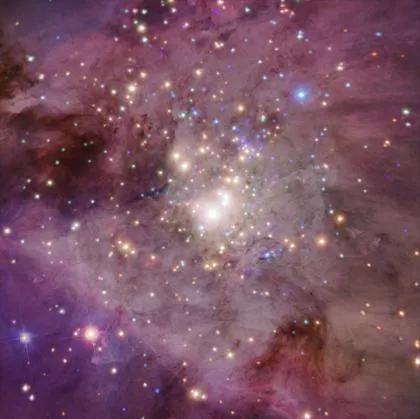
As a celebration of the 17th anniversary of the launch of the Hubble Space Telescope, a team of astronomers has published one of the largest panoramic images taken with the orbital observatory.
Via SpaceTelescope and HubbleSite
It is an image of the central region of the Carina Nebula. It is a mosaic formed by 48 shots taken with the ACS (Advanced Camera for Surveys). They were taken during March and July of 2005. Color information was added with data obtained between December 2001 and March 2003 at Cerro Tololo in Chile. Red corresponds to sulfur, green to hydrogen and blue to oxygen emission.
The nebula is about 7500 light-years away in the constellation Carina or Keel. Keel or Carina, is a constellation in the southern hemisphere located between those of Vela, Puppis, Volans and Chamaeleon. Together with the first two it formed the ancient constellation of Argo. The Milky Way crosses this constellation, whose main star, Alpha Carinae or Canopus, is the brightest in the sky after Sirius.
Also notable in this constellation is the star Eta Carinae, a variable star that was observed by Edmund Halley in 1677, when it was magnitude 4. Around 1843 it became as bright as Canopus, but since 1900 its magnitude has varied between 6 and 8.
Around this star there is a nebula two degrees wide and very easy to observe, even with binoculars. The constellation also contains several open star clusters, some of them quite bright.
More about the nebula:
http://www.fcaglp.unlp.edu.ar/~rbarba/news/carina/