A magnificent composite image from the Chandra and Hubble Observatories reveals the beauty of the Orion Nebula.
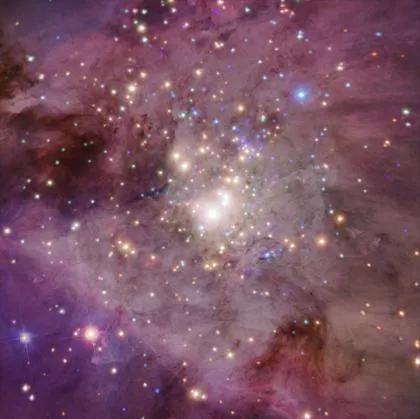
At a distance of 1,500 light-years, the Orion Nebula is one of the closest star-forming regions. This makes Orion an excellent place to study how stars are born and how they behave in their infancy. In this composite image, the central region of Orion is seen as never before through the Chandra X-ray Observatory and the Hubble Space Telescope.
The nearly point-like light sources (in blue and orange) in the image are the growing stars captured in X-rays by a long series of observations by Chandra, lasting up to 13 days. This allows astronomers to monitor the activity of Sun-like stars between 1 and 10 million years old. A higher intensity of X-rays is observed in these stars than in the Sun today. This suggests that our Sun had many violent and energetic outbursts when it was younger. The filaments (in red and purple) are clouds of gas and dust seen by Hubble in optical light. This gas and dust will one day condense into disks of material from which future generations of stars will be born.