The VLT interferometer detected a disk around an old star in a study to better understand the transformation of stars into "cosmic butterflies"
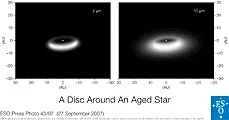
ESO PR Photo 43/07
A team of European astronomers used ESO's VLT Interferometer to discover dust trapped in a disk surrounding an old star. The discovery provides additional clues about the formation of planetary nebulae.
In the final stages of their lives, stars like our Sun evolve from red giants to white dwarfs. The transition is accompanied by the ejection of a large envelope of gas and dust producing what are known as planetary nebulae, which often shine in beautiful colors. The celestial chrysalis becomes a cosmic butterfly.
This metamorphosis, rapid in terms of stellar life, is quite complex and poorly understood. In particular, astronomers want to understand how a spherical star can produce a great variety of planetary nebulae, some with very asymmetric shapes.
A team of scientists, however, embarked on a study of a star that is currently in its phase of becoming a "cosmic butterfly". The star, V390 Velorum, is 5,000 times brighter than the Sun and is located 2,600 light-years away. It is known to have a companion.
Astronomers postulated that old stars with a companion possess a reservoir of dust that is believed to play an important role in the final chapters of their lives. The shape and structure of these reservoirs remain, however, unknown.
To scrutinize the object with great precision, the astronomers combined observations taken with ESO's powerful instruments, AMBER and MIDI on the VLT. In particular, they combined, using AMBER, the near-infrared light from three of the 8.2-meter Telescope units.
These observations clearly demonstrate that the presence of dust around the star cannot be distributed spherically. "This shows that whatever mechanism gives asymmetric shape to planetary nebulae is already present before the metamorphosis takes place," says Hans Van Winckel, a team member.
The astronomers found evidence of a disk extending from 9 to several hundred astronomical units. "This disk found around the star is in a brief stage of its life, but it is a very important phase," says Pieter Deroo, author of the paper presenting the results in Astronomy and Astrophysics.
"It is a period in which an enormous morphological change occurs toward the creation of a planetary nebula."
The very high-resolution measurements allowed the astronomers to determine the orientation and inclination of the disk. The disk is very similar to those found around young stars in which planets form.
Sources and related links
- Note on EurekAlert
- Note on ESO
Paper data: AMBER and MIDI interferometric observations of the post-AGB binary IRAS 08544-4431: the circumbinary disc resolved
P. Deroo, B. Acke, T. Verhoelst, C. Dominik, E. Tatulli, and H. Van Winckel
Accepted: 18 September 2007
DOI: 10.1051/0004-6361:20078079
Planetary nebulae gallery