According to observations made with NASA's Chandra X-ray Observatory and with ground-based optical telescopes, supernova SN 2006gy is the brightest and most energetic stellar explosion ever seen and could be a new type of supernova.
Via Chandra
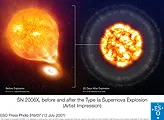
The image first shows an illustration of what SN 2006gy would look like at close range. In white, the explosion of a massive star is seen, whose debris generates two lobes of gas.
The green, blue, and yellow regions in these lobes show where the gas is being heated by the shock with the explosion material. Most of the optical light generated by the supernova is thought to come from the star's debris that has been heated by radioactivity, but some also comes from the heated gas.
The next image, bottom left, is an infrared image using adaptive optics at Lick Observatory of NGC 1260, the galaxy containing SN 2006gy. The more diffuse source is the center of the galaxy, while the much brighter one is the supernova. That is, that star explosion was much brighter than the entire galaxy that contained it.
The image on the right shows Chandra's capture of the core of NGC 1260 and the supernova. The observations allowed astronomers to determine that SN 2006gy was certainly caused by the collapse of a very massive star and not the other alternative explanation, the destruction of a low-mass star. If the supernova had been caused by a white dwarf, exploding into a dense, hydrogen-rich environment, SN 2006gy would have been about 1000 times brighter in X-rays than what Chandra detected.
The supernova, named SN 2006gy, was recorded at 240 million light-years away. The outburst occurred a long time ago but was detected last year, after its light traveled several trillion kilometers before it could be observed from Earth.
"That sounds very far away but it's actually quite close on the vast scale of the universe," said the research leader, astronomer Nathan Smith of the University of California at Berkeley, at a press conference.
The supernova was discovered in September 2006 and has become the brightest and most powerful ever seen, Smith indicated.
"Of all the star explosions seen before, this was by far the most powerful," said Alex Filippenko, one of the astronomers who made this discovery.
"We were surprised by its luminous intensity and also by its duration (70 days)," he added in a statement. The exploded star would have been as large as about 150 times our Sun.
Nevertheless, experts estimate that a similar outburst could occur in the Milky Way. Eta Carinae is located just 7,500 light-years away and is a neighbor of Earth. Some scientists believe that Eta Carinae is also heading towards a supernova explosion; that phenomenon, they assure, "could be the best stellar show of modern civilization."
Astronomers think that many of the first-generation stars were this massive, and this supernova could provide a rare glimpse into the end of such ancient stellar objects. It is unusual, however, to find such a massive star and witness its death. The discovery provides evidence that the death of such massive stars is fundamentally different from theoretical predictions.
In stars of such size, after consuming their nuclear fuel, the star collapses under its own gravity into a black hole.
Data from SN 2006gy suggest that the spectacular supernovae of the first stars, instead of collapsing in that way, may be more common than previously thought.
Under certain conditions, the core of a massive star produces so much gamma radiation that part of the radiation's energy converts into particle-antiparticle pairs. This causes the star to collapse and thermonuclear reactions ensue and the star explodes, scattering its remains into space.
The results of Smith and his colleagues will appear in The Astrophysical Journal.
More images at SN 2006gy Photo Album de Chandra