Astronomers find evidence of material surrounding a star before its explosion as a supernova. This lends credence to the scenario in which the explosion occurred in a system where a white dwarf is fed by a red giant.
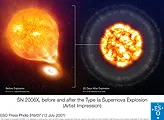
Illustration of SN 2006X, before and after the explosion. ESO PR Photo 31b/07.
Since Type Ia supernovae are extremely luminous and very similar to each other, these explosive events have been extensively used as a cosmological reference to trace the expansion of the universe.
However, despite significant recent progress, the nature of the exploding stars and the physics governing these powerful explosions have remained very poorly understood.
In most accepted models of Type Ia supernovae, a white dwarf orbits another star. Given the close interaction and the powerful attraction produced by the compact object, the companion star continuously loses mass, "feeding" the white dwarf. When the dwarf's mass exceeds a critical value, it explodes.
The team of astronomers studied in great detail SN 2006X, a Type Ia supernova that exploded 70 million light-years away from us, in the splendid spiral galaxy Messier 100. Their observations led them to discover the signature of material lost by the star, part of which is transferred to the white dwarf.
The observations were made with the Ultraviolet and Visual Echelle Spectrograph (UVES), mounted on ESO's 8.2m Very Large Telescope, on four different occasions, over four months. A fifth observation at a different time was secured with the Keck telescope in Hawaii. The astronomers also used radio data obtained with NRAO's Very Large Array, as well as images extracted from the NASA/ESA Hubble Space Telescope archive.
"No Type Ia supernova has been observed with this level of detail for more than four months after the explosion," says Ferdinando Patat, author of the paper reporting the results in this week's edition of Science Express.
The most notable discoveries are clear changes in the absorption of the material, which has been ejected from the giant companion star. Such changes in interstellar material have never been observed before and demonstrate the effects of a supernova explosion on its immediate surroundings. The astronomers deduce from the observations the existence of several gaseous clumps that are material ejected as stellar wind from the giant star in the recent past.
"The material we have discovered probably lies in a series of shells with radii on the order of 0.05 light-years, or approximately 3000 times the distance between Earth and the Sun. The material is moving at a speed of 50 km/s, implying that the material was ejected about 50 years before the explosion," explains Patat.
That speed is typical of red giant winds. The system that exploded was thus composed of a white dwarf that acted like a giant vacuum cleaner, removing gas from its red giant companion. In this case, however, the act was fatal for the white dwarf. This is the first time that clear and direct evidence of material surrounding the explosion has been found.
"A crucial question is whether what we have seen in SN 2006X represents the rule or an exceptional case," worries Patat. "But given that this supernova has not shown any peculiarities in the optical, ultraviolet, and radio, we conclude that what we have seen for this object is a common feature for Type Ia supernovae. Despite this, only future observations will give us answers to the questions these observations raise for us."
The results are reported in a paper in Science Express published on July 12, 2007, titled "Detection of circumstellar material in a normal Type Ia Supernova," by F. Patat et al.
Sources and related links
ESO press release
About the image:
Left: Artistic impression of the SN2006X system before the explosion. The white dwarf (on the right) accretes material from the red giant, which is losing gas in the form of stellar wind (the diffuse material around the giant). Only a part of this gas is accreted by the white dwarf, through the so-called accretion disk surrounding the compact star. The rest of the gas escapes the system and eventually dissipates into the interstellar medium. The red giant has a radius about 100 times that of the Sun, while the white dwarf is about 100 times smaller than our star.
Right: Once the white dwarf's mass reached a critical limit, a thermonuclear explosion shatters the star, ejecting its material at speeds up to one-tenth the speed of light. Twenty days after the explosion, when the supernova reaches its peak brightness, the ejected material has reached a size of approx. 450 times the Earth-Sun distance. The enormous amount of light emitted by the supernova passes through the material before being detected by us, and thus reveals the gas shells that were ejected by the red giant in the last few hundred years before the explosion.