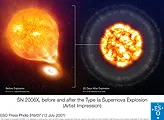
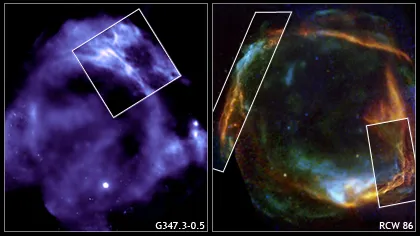
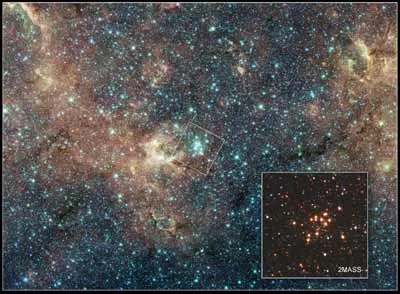
In the past six weeks, two supernovae exploded in a dark galaxy in the constellation Hercules. Astronomers had never before observed two of these powerful stellar explosions in the same galaxy and so close in time.
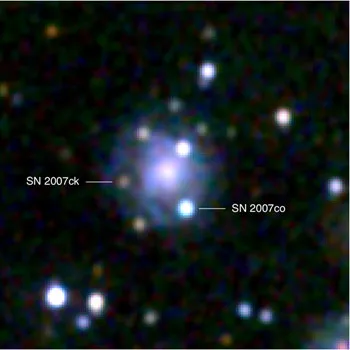
Supernova 2007ck (left) is a Type II event, and Supernova 2007co (right) is a Type Ia event. The image is a combination of red, green, and blue taken on June 9 and 12 by the ultraviolet/optical telescope on NASA's Swift satellite, which was designated to study another type of stellar explosion, gamma-ray bursts.
Credit: Stefan Immler NASA/GSFC, Swift Science Team.
The galaxy, known as MCG +05-43-16, is 380 million light-years from Earth. Until this year, astronomers had not seen supernovae in this congregation of stars. As if that weren't enough, both explosions are of different types.
The supernova 2007ck is a Type II event—which is triggered when the core of a massive star runs out of nuclear fuel and collapses gravitationally, producing a shock wave that blows the star to pieces.
This event was seen on May 19.
In contrast, Supernova 2007co is a Type Ia event, which occurs when a white dwarf accretes too much material from a companion and explodes like a giant thermonuclear bomb. It was discovered on June 4. A white dwarf is the exposed core of a star after it has ejected its atmosphere; it is approximately the size of our planet but its mass is like that of our Sun, meaning it is very dense.
"Most galaxies have a supernova every 25 to 100 years, so it is remarkable for a galaxy to have two explosions discovered 16 days apart," said Stefan Immler of NASA's Goddard Space Flight Center.
In 2006, Immler used the Swift satellite to see two supernovae in the elliptical galaxy NGC 1316, but both were of the same type, Ia, and were discovered six months apart.
The simultaneous appearance of two supernovae in a galaxy is an extremely rare event, but it is merely a coincidence and implies nothing unusual about the galaxy. Since the supernovae are thousands of light-years apart from each other, and since light travels at a finite speed, astronomers who might be in the galaxy itself or in a different one would have seen the two explosions thousands of years apart.