Astronomers from the University of California, using the powerful technology of adaptive optics at the Keck Observatory in Hawaii, revealed the presence of two supermassive black holes at the center of a galaxy collision 300 million light-years away.
Via EurekAlert
The new observations of NGC 6240, a butterfly-shaped galaxy that is the product of the collision of two smaller galaxies, revealed that each of the black holes resides at the center of the center of rotation of the stars.
"The study of the interaction between merging galaxies, star formation, and black hole accretion activity is crucial for our understanding of the evolution of the universe into the galaxies and structures we see today," said Gabriela Canalizo of the Institute of Planetary Physics at the University of California.
Canalizo worked with Claire E. Max, the leader of the paper, and with Willem H. de Vries.
"NGC 6240 is a system of a pair of galaxies caught in the act of merging," commented Canalizo. "It presents itself as an ideal laboratory to study and test our current models of galactic evolution. It not only exhibits black hole accretion, also called Active Galactic Nuclei (AGN, for its acronym in English), but also prodigious star formation and a galaxy merger in progress. Furthermore, the black holes are in the process of merging and the system is very close to us, making it easier to observe in detail. At 300 million light-years away, NGC 6240 would be in our backyard, compared to most active nuclei in the universe."
Previous studies had discovered the presence of two active galactic nuclei. "This pair of galaxies has been observed at different wavelengths and what appeared to be two black holes has been seen, but it has been very difficult to match those observations with each other," explained Claire Max, a professor of astronomy and astrophysics and director of the Center for Adaptive Optics. "Adaptive optics allowed us to link all [the observations] together, so now we can really see everything: the hot gas in the infrared, the stars in the visible and infrared, and the X-ray and radio emissions coming from the black holes."
Adaptive optics (AO) is a system comprised of telescopes, computers, and mirrors that allows counteracting the blurring effects of the planet's turbulent atmosphere that degrades the image seen by ground-based telescopes.
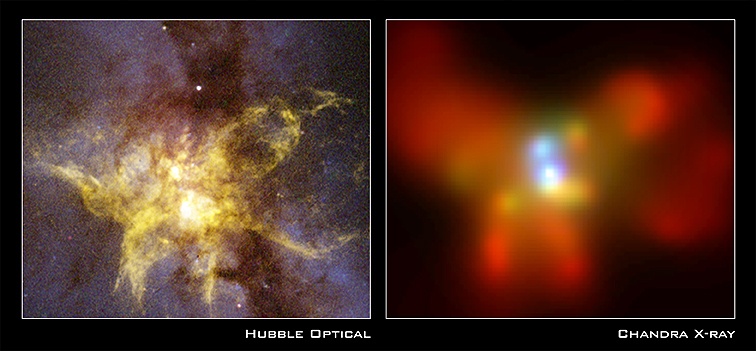
Images of NGC 6240 in visible light, from the Hubble Space Telescope, show the outer regions of the colliding galaxies distorted by the merger producing long streams of stars, gas, and dust. In the bright central region, two nuclei can be discerned, but clouds of dust obscure much of the visible light from the center. Images in X-rays from the Chandra Space Telescope in 2002 demonstrated their existence. Two point sources of light were detected in the region.
According to the research team, the holes will eventually merge, producing a powerful outburst. This could occur between 10 million to 100 million years from now.
Canalizo, who was in charge of planning and carrying out the AO observations on the 10m Keck II telescope, processed the near-infrared data. De Vries made precise measurements of the positions of astronomical objects in the sky, allowing the researchers to match the near-infrared data with images from other wavelengths.
The results appear online in Science Express and will be published in the print edition of Science.
Press release from the University of California.
More photos on the Chandra Observatory site.