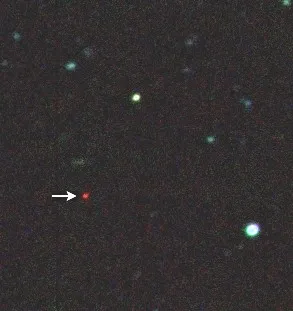
The majestic spiral galaxy we live in was created billions of years ago through mergers with larger galaxies. And, it is thought, that in 5 to 10 billion years, it will merge with Andromeda. Both galaxies would have supermassive black holes in their centers. What will happen to them when the galaxies merge? One possibility is that one of the black holes is expelled from the center of the galaxy in combination at a tremendous speed.
Via Universe Today
The velocities and gravitational forces are so powerful during the merger of black holes that it is possible for one of these objects to be expelled by the other. Until now, it was believed that the black hole would lose its accretion disk, making it impossible to detect.
But new calculations performed by Avi Loeb, a researcher at the Harvard-Smithsonian Center for Astrophysics, indicate that an expelled black hole would be capable of taking its accretion disk with it. And the spilled radiation would be detectable here on Earth.
If the calculations are correct, the merging black holes would release large amounts of gravitational radiation in the direction of their orbits. The momentum of this radiation would give the resulting black hole from the combination a kick in the opposite direction, ejecting it at 16 million kilometers per hour. At this speed, it would cross its entire galaxy in only 10 million years.
According to Loeb, since the gas in the disk is orbiting at a much greater speed than the ejection speed, it would follow the black hole on its journey.
After the black holes become one, upon merging, the accretion disk could feed the remnant black hole for millions of years, allowing the black hole to shine like a quasar.
Before the black hole's fuel runs out, it could travel more than 30 thousand light-years from the center of its galaxy. At cosmological distances, that would equate to a separation in the sky of around 1 arcsecond. Those separations are exciting to detect since the brightness of quasars could overwhelm the galaxy.
The powerful release of energy from a quasar shapes the evolution of its host galaxy. Previous theoretical calculations assumed that a quasar remained tied to the center of its galaxy where most of the gas is concentrated. "However, the feedback from a recoiling quasar would be distributed along its trajectory and would resemble the trail of a subatomic particle in a bubble chamber," commented Loeb.
"Most importantly, this work is good motivation for observers to search for displaced quasars," concluded the scientist.
The paper has been accepted for publication in Physical Review Letters and is available online at http://xxx.lanl.gov/abs/astro-ph/0703722.
Original source: CfA Press Release