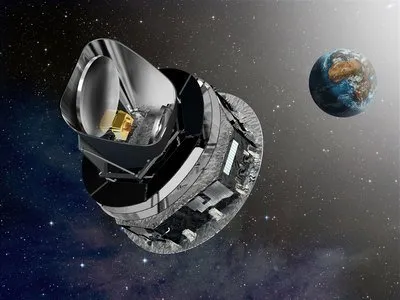
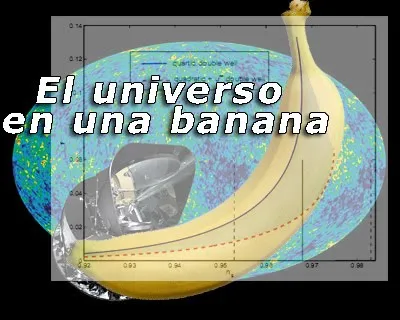
A new analysis of WMAP data and large-scale structures provides interesting limits to inflationary theory, in a work in which Norma G. Sánchez (Director of the International School of Astrophysics "Daniel Chalonge") and Héctor J. de Vega, Argentine scientists in France, participated.
The results of the WMAP satellite (Wilkinson Microwave Anisotropy Probe) on the cosmic microwave background radiation (CMB), together with large-scale structure and dark energy observations place the early epoch of cosmic inflation (primordial acceleration of expansion) within the framework of the Standard Model of the Universe.
WMAP data play a key role in establishing the standard model of the Universe. The model explains a great variety of astronomical and cosmological measurements made at different wavelengths and with different tools. The concordance of these data imply that we live in a flat Universe, with gravity and cosmological perturbations described by Einstein's General Theory of Relativity, in three spatial dimensions.
Currently, as far as is known, the Cosmos is dominated by dark energy (72%), dark matter (23%) and atoms (5%). Dark energy is a repulsive force, a kind of antigravity and is responsible for the acceleration of the expansion of the Universe. Dark matter is made up of particles that are not like the atoms we know, they do not emit or absorb light and have only been detected by their gravitational action.
Inflation is the primordial stage of the expansion of the Universe in which the cosmos expanded its size by at least a factor of 1026. This inflationary period lasted approximately 10-34 seconds.
The fluctuations observed in the CMB are explained by inflation. Microscopic quantum fluctuations evolved through inflation into macroscopic differences.
This inflation is described by a scalar field, called the inflaton. The concept of inflation solves important issues of the standard cosmological big bang theory. The inflationary concept was originally proposed by Alan Guth, whom we had already talked about and whose interview with Alicia Rivera about the Big Bang and inflation, we cited some time ago.
Primordial gravitational waves are a robust prediction of inflation since they are produced by the same mechanism that generated the primordial density fluctuations observed in CMB and LSS data.
Recently, in an article published in Physical Review, a team of theorists from the Paris Observatory, the distinguished Argentine scientists Norma G. Sánchez and Héctor J. de Vega, research directors at CNRS, Centre National de la Recherche Scientifique (National Center for Scientific Research, France), together with Claudio Destri of INFN/University of Milano-Bicocca, performed a new analysis of all available CMB and LSS data including WMAP and Sloan data and revealed the existence of primordial gravitational waves.
As I understand it, they used statistical algorithms called Markov Chain Monte Carlo (MCMC). This new analysis is achieved within a new approach to inflation in the spirit of Ginsburg-Landau theory. This approach is a powerful tool in elementary particle physics and condensed matter physics. In this new analysis, the precise shape of the inflationary potential is constructed with MCMC in agreement with WMAP and LSS data.
The team derived formulas from the CMB data and studied them: density fluctuation index, tensor of fluctuations, etc. These analytical formulas were introduced as strong limits in the numerical programming for the analysis.
This analysis of the data differs from previous CMB analyses, in particular that of WMAP (including the recently released analysis of its 5 years)
Within the framework of their model, some of the new results are:
That the data strongly indicate the breaking of the symmetry of the inflaton potentials AND that the amount of the tensor fluctuation rate (primordial gravitational waves) is not zero and that it could be reduced even further with the use of the 5-year WMAP data and future CMB data.
Two years ago, the Argentines Norma G. Sánchez and Héctor J. de Vega were in the headlines for their work on the origin of the Universe (as we commented in "Argentine scientists reveal new secrets about the origin of the Universe" and received the copy of the Nobel medal from the 2006 prize-winning physicist George Smoot. In October 2007, the two scientists were the Argentine representatives at the Interministerial Roundtable on Science, Technology and Sustainable Development.
A national pride, of cosmic scales.
Sources and related links
- A new analysis of WMAP and large-scale structure data yields interesting constraints on the inflation theory
- Monte Carlo Markov chains analysis of WMAP3 and SDSS data points to broken symmetry inflaton potentials and provides a lower bound on the tensor to scalar ratio
C. Destri, H. J. de Vega, and N. G. Sanchez
URL: http://link.aps.org/abstract/PRD/v77/e043509
doi:10.1103/PhysRevD.77.043509
PACS: 98.80.Cq, 05.10.Cc, 11.10.-z - MCMC analysis of WMAP3 and SDSS data points to broken symmetry inflaton potentials and provides a lower bound on the tensor to scalar ratio
C. Destri, H. J. de Vega, N. G. Sanchez
About the images
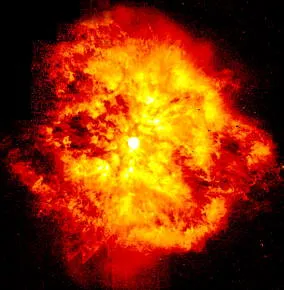
Illustration of a cosmic explosion