This is a project carried out with the collaboration of more than 500 students from ESA member countries, the USA, Japan, Canada and Australia.
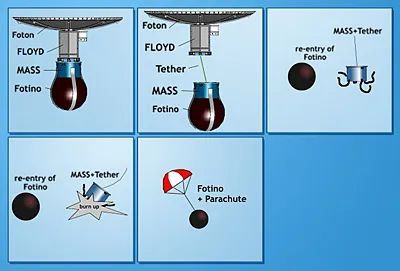
The Fotino capsule descends on a pulley to re-enter the atmosphere. Credit: Marco Stelzer
After 5 years of design and development of the flight model, the second Young Engineers Satellite (YES) passed its final acceptance review and has the green light for its launch in September.
The experiment will fly on an ESA microgravity mission, Foton-M3.
During its flight, it will deploy its own mini-satellite and re-entry vehicle, called Fotino.
There are three main components in the experiment:
-FLOYD, the deployment mechanism located on the Foton spacecraft;
-MASS, the support system;
-FOTINO, a small spherical capsule, with a diameter of 40 cm and a mass of 5.5 kg.
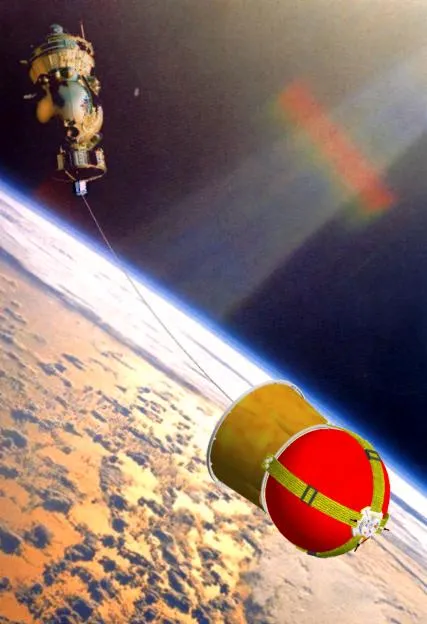
During the flight, FLOYD will execute the other two components. They will then be controlled by the deployment of a 30 km tether. Orbital dynamics will cause the Fotino capsule to be positioned in front of the mother ship. A pendulum motion will then be induced in the tether and then the capsule will be released from the tether. Since at that moment the capsule will be going too slow to remain in orbit, it will begin to re-enter the atmosphere, from an altitude of about 250 km, protected by a heat shield made of novel materials. When it reaches an altitude of 5 km, a parachute will open to ensure a soft landing in the steppes of Kazakhstan.
There are several notable aspects to the innovative mission:
YES2 provides hundreds of students with a highly motivating and educational experience;
The mission involves the first use of a tether to return a payload from space. This will pave the way for a safe, low-cost return capability that will offer an alternative to conventional rocket propulsion;
The tether will be the longest artificial structure ever deployed in space. It is made of Dyneema, the strongest fiber even though it is only 0.4 mm thick and weighs only 5 kg!
Sources and related links
- ESA press release
- Yes2 website