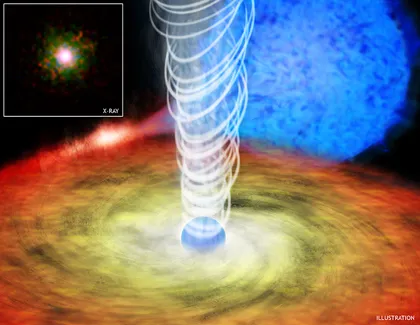
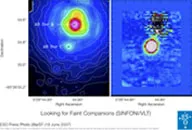
Weather -caused by the same forces as here on Earth- seen on a star for the first time, reveals clouds of mercury on a star called Alpha Andromedae.
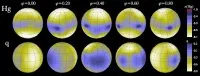
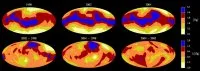
Illustration: Kochukhov et al./Nature
Previously, astronomers thought that any structure on stars was caused by magnetic fields. Sunspots, for example, are relatively cold regions on the Sun where powerful magnetic fields impede the flow of energy.
But now, after seven years of meticulous observations of Alpha Andromedae, they show that stars do not need magnetic fields to form clouds, after all.
About 100 light-years away, it is a class of star unusually rich in mercury and manganese. Previous observations of similar stars revealed an uneven distribution of mercury, but all had powerful magnetic fields.
Relatively massive stars do not mix gases in their atmospheres, as lower-mass stars do, like our Sun. So the balance between the pull of gravity and the pressure of radiation concentrates some heavy elements at certain atmospheric levels. At that point, their magnetic fields, it was thought, continued the separation process, setting aside some elements in particular regions.
But researchers led by Oleg Kochukhov of Uppsala University in Sweden found that this last step is not necessary to create chemical clouds on a star.
The scientists observed the concentration of mercury in Alpha Andromedae -which has no magnetic field that has been observed in seven years with telescopes- detecting the mercury by its signature in the absorption line at the violet end of the spectrum.
The surface details were obtained by observing how quickly the clouds approached or moved away from Earth. That revealed that the mercury concentration varies by a factor of 10000 across its surface and the pattern of the concentration also varies.
Evidence of changes in the distribution of mercury over time "seems convincing," comments Gregg Wade, who discovered in 2006 the lack of a magnetic field in the star.
But what exactly causes the clouds to change is not clear. The researchers say the changes could have the same physics as weather on giant planets or like Earth.
The mercury clouds are on the larger and more luminous member of a pair of stars that orbit each other every 97 days. "The second star could create tides on the surface of the primary star, like the Moon creates them on Earth, which leads to the evolution of the mercury cloud cover," explains researcher Kochukhov.
But he adds that other explanations are possible, so the weather of stars, as on our planet, remains difficult to predict.
Sources and related links
- NewScientist:Weather observed on a star for the first time
- Space.com:Stars Have Earth-Like Weather
- Nature Physics:Weather in stellar atmosphere revealed by the dynamics of mercury clouds in alpha Andromedae