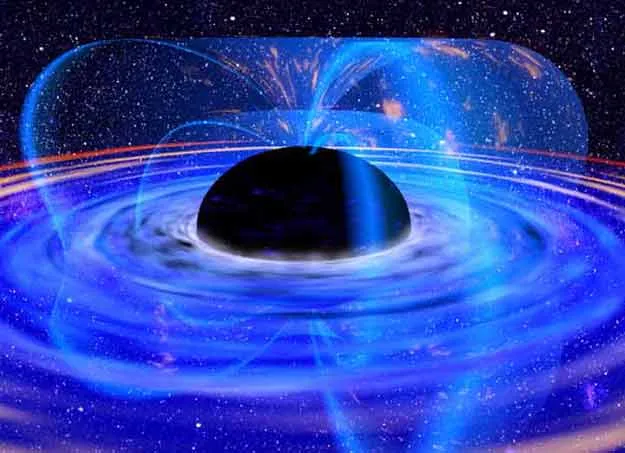
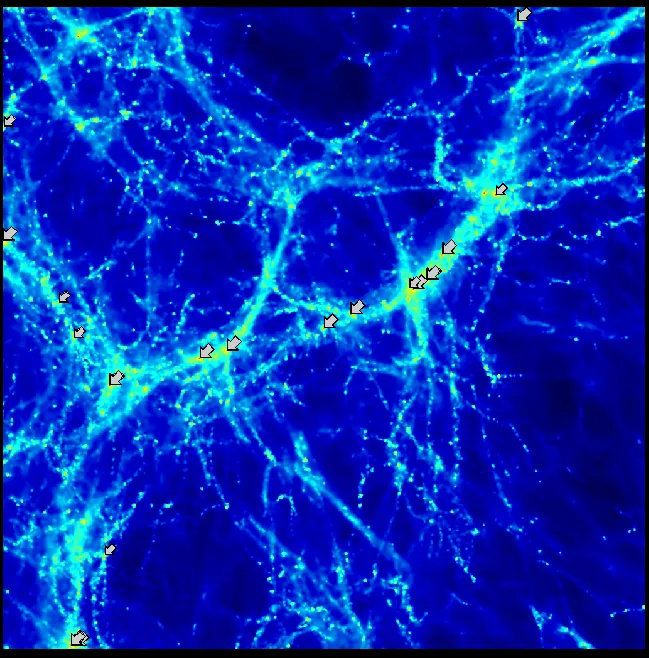
Recently, in a paper by scientists from Case Western University, the existence of black holes was called into question, concluding that they cannot form the event horizons that characterize them.
To better understand what we are talking about, an article by Stephen Hawking published in Scientific American in January 1977 and compiled in his book Black Holes and Small Universes is published.

The great development of astronomical observations that began at the start of the sixties sparked a renewal of interest in the classical theory of general relativity because it seemed that many of the newly discovered phenomena, such as quasars, pulsars, and compact X-ray sources, indicated the existence of very intense gravitational fields that could only be described by means of general relativity. Quasars are objects of stellar appearance that must be much brighter than entire galaxies if they are as distant as the redshift of their spectra indicates; pulsars are the rapidly blinking remnants of supernova explosions, considered to be very dense neutron stars; the compact X-ray sources, revealed by instruments installed on spacecraft, could also be neutron stars or perhaps hypothetical objects of even greater density, that is, black holes.
One of the problems faced by physicists who tried to apply general relativity to these newly discovered or hypothetical objects was making them compatible with quantum mechanics. In recent years, progress has been made that encourages the hope that in a not-too-distant future we will have a fully consistent quantum theory of gravity, compatible with the general theory for macroscopic objects and free, I trust, from the mathematical infinities that have long plagued other quantum field theories. These advances are related to certain recently discovered quantum effects associated with black holes. These quantum effects reveal a remarkable relationship between black holes and the laws of thermodynamics.
I will briefly describe how a black hole can arise.
Imagine a star with a mass ten times that of the Sun. For most of its existence, about a billion years, the star will generate heat in its core, transforming hydrogen into helium. The released energy will create enough pressure for the star to support its own gravity, resulting in an object with a radius five times that of the Sun. The escape velocity of such a star would be about a thousand kilometers per second, that is, an object fired vertically from the surface of the star would be held back by its gravity and would return to the surface if its speed were less than a thousand kilometers per second, while an object at a higher speed would escape to infinity. When the star has consumed its nuclear fuel, nothing will remain to maintain the outward pressure and the star will begin to contract under its own gravity. As the star shrinks, the gravitational field on its surface will become stronger and the escape velocity will rise to three hundred thousand kilometers per second, the speed of light. From that moment on, light emitted by that star will not be able to escape to infinity because it will be held back by the gravitational field. According to the special theory of relativity, nothing can travel at a speed greater than that of light, so nothing will escape, if light cannot get out.
The result will be a black hole: a region of space-time from which it is impossible to escape to infinity. The boundary of the black hole is called the event horizon.
It corresponds to a shock light wave from the star that fails to leave for infinity and remains stopped at the Schwarzschild radius: 2*GM/c, where G is Newton's gravitational constant, M is the mass of the star, and c, the speed of light. For a star of about ten solar masses, the Schwarzschild radius is about thirty kilometers. There is sufficient observational data indicating that there are black holes of approximately this size in double star systems like the X-ray source known as Cygnus X-1. Furthermore, there may be scattered throughout the universe a certain number of much smaller black holes whose origin is not the collapse of stars, but highly compressed regions of the dense and hot medium believed to have existed shortly after the Big Bang that gave rise to the universe. Such 'primordial' black holes are of great interest for the quantum effects I will describe. A black hole weighing a billion tons (approximately the mass of a mountain) would have a radius of 1E-13 centimeters (the size of a neutron or a proton); it could orbit around the Sun or the center of the galaxy. The first glimpse of a possible relationship between black holes and thermodynamics came in 1970 with the mathematical discovery that the surface of the event horizon, the boundary of a black hole, has the property of always increasing when additional matter or radiation falls into the black hole. Moreover, if two black holes collide and merge into one, the area of the event horizon around the resulting black hole is greater than the sum of the areas of the event horizons of the original black holes. These properties indicate that there is a similarity between the area of a black hole's event horizon and the concept of entropy in thermodynamics. Entropy can be considered as a measure of the disorder of a system or, correspondingly, as a lack of knowledge of its precise state. The famous second law of thermodynamics says that entropy always increases with time.
James M. Bardeen of the University of Washington, Brandon Carter, who works at the Meudon Observatory, and I have extended the analogy between the properties of black holes and the laws of thermodynamics. The first law of thermodynamics states that a small change in the entropy of a system is accompanied by a proportional change in the energy of the system. The fact of the proportionality is called the temperature of the system.
Bardeen, Carter and I found a similar law that relates the change in mass of a black hole to the change in the area of the event horizon. Here the proportionality factor involves a quantity called surface gravity, which is a measure of the strength of the gravitational field at the event horizon. If it is accepted that the area of the event horizon is analogous to entropy, then it seems that the surface gravity must be equal at all points on the event horizon, just as the temperature is equal at all points of a body in thermal equilibrium.
Although there is clearly a resemblance between entropy and the area of the event horizon, the way to identify the area with the entropy of a black hole seemed obvious to us. What can be understood by the entropy of a black hole? The crucial statement was formulated in 1972 by Jacob D. Bekenstein, who was then a postgraduate student at Princeton University and now works at the University of Negev, in Israel. It goes like this: when a black hole is created by gravitational collapse, it quickly enters a stationary situation characterized only by three parameters: mass, angular momentum and electric charge. Apart from these three properties, the black hole does not retain any other characteristics of the object that contracted. This conclusion, known as the theorem that "a black hole has no hair," was demonstrated by the collaborative work of Carter, Wemer Israel, of the University of Alberta, David C. Robinson, of King's College, London, and myself.
The no-hair theorem implies that a large amount of information is lost during gravitational contraction. For example, the final state of the black hole is independent of whether the contracting body was composed of matter or antimatter, whether it was spherical or very irregular in shape. In other words, a black hole of a given mass, angular momentum and electric charge could have arisen from the collapse of any of the very many different configurations of matter. And if quantum effects are not taken into account, the number of configurations would of course be infinite, since the black hole could have been formed by the collapse of a cloud of an infinitely large number of particles of an infinitely small mass.
The uncertainty principle of quantum mechanics implies, however, that a particle of mass m behaves like a wave of wavelength h/mc, where h is Planck's constant (the small figure of 6.62E27 ergs per second) and c is the speed of light. For a cloud of particles to be able to contract to form a black hole, it seems necessary that this wavelength be smaller than the size of the black hole thus formed. It follows that the number of configurations capable of forming a black hole of a given mass, angular momentum and electric charge, although very large, may be finite. Bekenstein stated that it is possible to interpret the logarithm of this number as the entropy of a black hole. The logarithm of the number would be a measure of the volume of information that is irretrievably lost during the collapse through an event horizon when a black hole arises. The apparently fatal flaw in Bekenstein's statement was that, if a black hole possesses a finite entropy, proportional to the area of its event horizon, it must also have a finite temperature that would be proportional to its surface gravity. That would mean the possibility that a black hole could be in equilibrium with thermal radiation at a temperature other than absolute zero. But such equilibrium is not possible according to classical concepts, because the black hole would absorb any thermal radiation that fell there, but, by definition, could not emit anything in return.
This paradox persisted until early 1974, when I was investigating what the behavior of matter in the vicinity of a black hole would be, according to quantum mechanics. I discovered, to my great surprise, that the black hole seemed to emit particles at a constant rate. Like everyone else at the time, I accepted the dogma that a black hole could not emit anything. That is why I tried as hard as I could to get rid of such a puzzling effect. It refused to disappear, so, in the end, I had to accept it. What finally convinced me that it was a genuine physical process was that the emitted particles possess a precisely thermal spectrum: the black hole creates and emits particles as if it were an ordinary warm body with a temperature directly proportional to the surface gravity and inversely proportional to the mass. This made Bekenstein's statement, that a black hole possesses a finite entropy, completely consistent, since it implied that a black hole could be in thermal equilibrium at some finite temperature other than zero. Since then, the mathematical proof that black holes can perform thermal emissions has been confirmed by other researchers with different approaches. Here is one way to understand that emission. Quantum mechanics implies that the whole of space is occupied by pairs of "virtual" particles and antiparticles that constantly materialize in pairs, separating and coming together to annihilate each other. These particles are called virtual because, unlike "real" ones, they cannot be observed directly by a particle detector; however, their effects can be measured indirectly and their existence has been confirmed by a small shift (the "Lamb shift") that they cause in the light spectrum of excited hydrogen atoms. In the presence of a black hole, one member of a pair of virtual particles can fall into the hole, leaving the other member without a partner to annihilate with. The abandoned particle or antiparticle may fall into the black hole after its partner, but it is also possible that it escapes to infinity where it appears as radiation emitted by the black hole.
Another way to examine the process is to consider the member of the particle pair that falls into the black hole—for example, the antiparticle—as a particle that actually travels backward in time. Thus, the antiparticle falling into the black hole can be seen as a particle emerging from it but going backward in time. When the particle reaches the point where the particle-antiparticle pair originally materialized, it is scattered by the gravitational field and consequently moves forward in time.
Quantum mechanics has allowed a particle to escape from inside a black hole, a possibility denied by classical mechanics. There are many other situations in atomic and nuclear physics where there is a certain type of barrier that particles could not overcome according to classical principles, but which they cross due to the principles of quantum mechanics.
The thickness of the barrier around a black hole is proportional to its size. This means that very few particles can escape from a black hole as large as the one thought to exist in Cyg X-1, but they manage to exit very quickly from smaller black holes. Detailed calculations reveal that the emitted particles have a thermal spectrum corresponding to a temperature that increases rapidly as the mass of the black hole decreases. For a black hole with the mass of the Sun, the temperature is only one ten-millionth of a degree above absolute zero. The thermal radiation emitted by a black hole at such a temperature would be completely drowned out by the general background radiation of the universe.
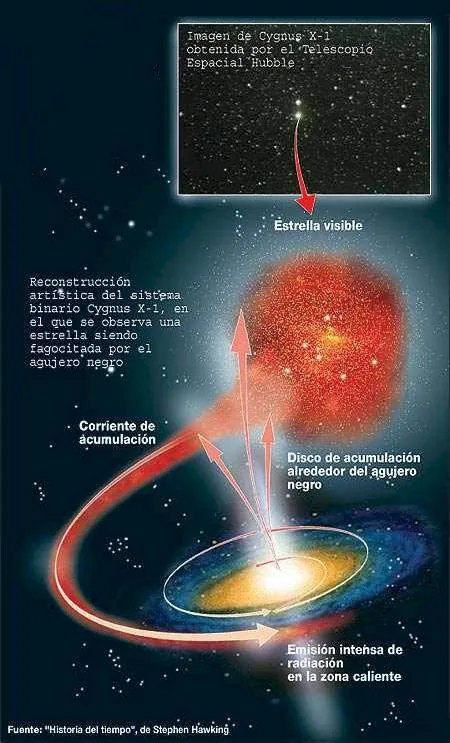
On the other hand, a black hole with a mass of only one billion tons, that is, a primordial black hole approximately the size of a proton, would reach a temperature of about 120 billion degrees Kelvin, which corresponds to an energy of about ten million electron volts. At such a temperature, a black hole would be capable of creating electron-positron pairs and massless particles, such as photons, neutrinos, and gravitons (the presumed carriers of gravitational energy). A primordial black hole would release energy at a rate of six thousand megawatts, equivalent to the output of six large nuclear power plants. As a black hole emits particles, its mass and size constantly decrease, which facilitates the escape of more particles and thus the emission will proceed at an ever-increasing rate until the black hole finally disappears. In the long term, every black hole in the universe will become extinct in this way, but as far as large black holes are concerned, the time will certainly be very long: one with the mass of the Sun will last about 10 to the 66 years. On the other hand, a primordial black hole should have almost completely disappeared in the ten billion years that have passed since the Big Bang, the beginning of the universe as we know it. Those black holes must now be emitting intense gamma radiation with an energy of about one hundred million electron volts.
God not only plays dice, but he sometimes throws them where they cannot be seen.
The calculations performed by Don N. Page of the California Institute of Technology and by me, based on measurements of the cosmic gamma-ray background made by the SAS-2 satellite, show that the average density of primordial black holes in the universe must be less than two hundred per cubic light-year. The local density in our galaxy could be a million times higher than this figure, if black holes were concentrated in the galactic "halo," the faint cloud of fast-moving stars that envelops each galaxy, rather than being uniformly distributed throughout the universe. That would mean that the nearest primordial black hole to Earth is probably at a distance no less than that which separates us from Pluto. The final stage of a black hole's disappearance can proceed so rapidly that it would end in a tremendous explosion. The intensity of this would depend on the number of different species of elementary particles it contains. If, as is widely believed, all particles are composed of up to six different varieties of quarks, the final explosion would have an energy equivalent to that of about ten million one-megaton hydrogen bombs. On the other hand, an alternative theory formulated by R. Hagedorn of the European Council for Nuclear Research states that there is an infinite number of particles of ever-increasing mass. As a black hole shrinks and heats up, it will emit an ever-increasing number of different species of particles and produce an explosion perhaps one hundred thousand times more powerful than that calculated according to the quark hypothesis. Hence, observing the explosion of a black hole would provide elementary particle physics with extremely important information, which perhaps is not accessible in any other way.
The explosion of a black hole would produce a huge outpouring of high-energy gamma rays. Although they can be observed by gamma-ray detectors installed on satellites or balloons, it would be difficult to launch a detector into space large enough to record a reasonable chance of intercepting a significant number of gamma-ray photons from an explosion. It might be possible to use a space shuttle to build a large gamma-ray detector in orbit. A much easier and cheaper alternative would be to let Earth's upper atmosphere operate as a detector. A high-energy gamma radiation penetrating the atmosphere would create a shower of electron-positron pairs, which initially would travel through the atmosphere faster than light. (Light loses speed in its interactions with air molecules.) Thus, electrons and positrons would create in the electromagnetic field a kind of sonic boom or shock wave, called Cherenkov radiation, which could be detected from the Earth's surface as a flash of visible light.
A preliminary experiment by Neil A. Porter and Trevor C. Weekes of University College Dublin indicates that if black holes explode in the manner predicted by Hagedorn's theory, fewer than two black hole explosions occur per cubic light-year per century in our region of the galaxy, which would imply that the density of primordial black holes is less than one hundred million per cubic light-year. It should be possible to considerably increase the precision of such observations, which would be very valuable, even if they yield no positive evidence for primordial black holes. By setting a low upper limit on the density of such black holes, the observations would indicate that the early universe had to be very smooth and free of turbulence.
The Big Bang resembles the explosion of a black hole, but on a vastly larger scale. Therefore, it is reasonable to expect that an understanding of how black holes create particles will lead to a similar understanding of how the Big Bang created the entire universe. In a black hole, matter contracts and disappears forever, but in its place, new matter is created.
Thus, there may have been a previous phase of the universe in which matter contracted to be recreated in the Big Bang.
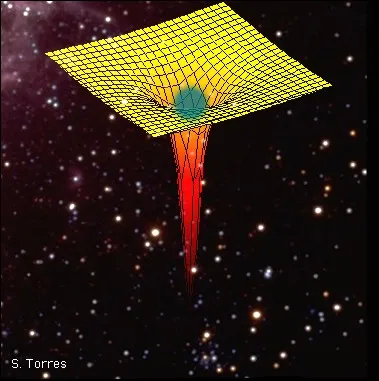
If the matter that contracts to form a black hole possesses a net electric charge, the resulting black hole will have the same charge. This means it will tend to attract those members of the virtual particle/antiparticle pairs that have the opposite charge and repel those with the same charge. For this reason, the black hole will preferentially emit particles with the same sign of charge as its own and thus will quickly lose its charge. Similarly, if the contracting matter possesses a net angular momentum, the resulting black hole will rotate and will preferentially emit particles that carry away its angular momentum. The reason a black hole "remembers" the electric charge, angular momentum, and mass of the matter that contracted and "forgets" everything else is that these three quantities are coupled to long-range fields: in the case of charge, to the electromagnetic field, and in the case of angular momentum and mass, to the gravitational field.
Experiments conducted by Robert H. Dicke of Princeton University and Vladimir Braginsky of Moscow University indicate that there is no long-range field associated with the quantum property called baryon number. (Baryons form the class of particles that includes the proton and neutron.) Hence, a black hole formed from the collapse of a collection of baryons would forget its baryon number and radiate equal amounts of baryons and antibaryons. Therefore, upon the disappearance of the black hole, it would transgress one of the most cherished laws of particle physics, the law of baryon conservation.
Although Bekenstein's hypothesis, that black holes possess a finite entropy, requires, for consistency, that such holes radiate thermally, at first it seems a complete miracle that the detailed quantum-mechanical calculations of particle creation yield an emission with a thermal spectrum. The explanation is that the emitted particles escape from the black hole, from a region about which the external observer knows nothing more than its mass, angular momentum, and electric charge. This means that all combinations or configurations of emitted particles that have the same energy, angular momentum, and electric charge are equally probable. Of course, it is possible that the black hole could emit a television set or the works of Proust in ten volumes bound in leather, but the number of particle configurations corresponding to these exotic possibilities is vanishingly small. By far, the greatest number of configurations corresponds to an emission with a spectrum that is almost thermal.
The emission from black holes possesses an additional degree of indeterminacy or unpredictability beyond that normally associated with quantum mechanics. In classical mechanics, one can predict the results of a measurement of a particle's position and velocity. In quantum mechanics, the uncertainty principle indicates that only one of these measurements can be predicted; the observer can predict the result of measuring position or velocity, but not both. Alternatively, they will be able to predict the result of measuring a combination of position and velocity. Thus, the observer's ability to make definite predictions is, in effect, halved. The situation is even worse with black holes. Since the particles emitted by a black hole come from a region about which the observer has very limited knowledge, they cannot predict definitely the position or velocity of a particle or any combination of the two; all that can be predicted are the probabilities that certain particles will be emitted. It seems Einstein was doubly wrong when he said God does not play dice. Considering the emission of particles from black holes would indicate that God not only plays dice but sometimes throws them where they cannot be seen.
Sources and related links
- Astocosmo: Structure of the Invisible
- Book in pdf: "Black Holes and Small Universes"
- Book in pdf, flash and various formats on Scribd thanks to user martimarti
- Books by Stephen Hawking
- Union between quantum and gravity in the superposition of an elephant