The planet's center of mass moves more than a millimeter each year. Thanks to innovative techniques, NASA has obtained a more accurate datum of the deepest point of our planet, which will allow, they assure, making more accurate estimates regarding the rise in sea level due to the effect of climate change.
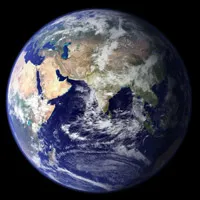
Image credit: NASA/GSFC
Via Europapress and JPL
NASA's latest discovery has shattered the dream that Jules Verne once had of reaching the center of the Earth. Apparently, according to American scientists, that place that the French writer imagined as a Mesozoic underworld is not an immobile point, but rather the planet's center of mass moves more than a millimeter each year. Thanks to innovative techniques, the US space agency has obtained a more accurate datum of the deepest point of our planet, which will allow, they assure, making more accurate estimates regarding the rise in sea level due to the effect of climate change.
Currently, scientists define the center of the Earth in two ways, as the center of mass of the solid Earth or as the center of mass of the entire Earth, which would include the solid part of the planet, the polar ice caps, the oceans and seas, and the atmosphere. Thus, according to Donald Argus, from NASA's Jet Propulsion Laboratory (JPL) and inventor of the new technique for measuring the center of the Earth, there is sufficient margin to improve the calculations made so far within those estimates.
"The two past estimates of the motion of the Earth's center of mass system, made in 2000 and 2005, differ by 1.8 millimeters each year," says Argus, who adds that these differences suggest that "the measurement of the Earth's center of mass is not as good as we would like." In this sense, the scientist explains that movements in mass attributable to the atmosphere and oceans depend on the season and are not significant enough to explain by themselves a movement of the Earth's center.
According to NASA, this new discovery can make important contributions to understanding climate change, since the widespread belief that it is occurring is that sea level is rising, which is attributed to the melting of large masses in Greenland or Antarctica. In recent years, sea level has risen rapidly, specifically a total of 3 millimeters per year. However, the inaccuracies that have been demonstrated when measuring the movement of the Earth's center of mass indicate that sea level measurements could also be incorrect.
AT THE LIMITS OF THE UNIVERSE
"Knowing the relative motions of the center of mass of the entire Earth and the center of mass of the solid Earth can help scientists better determine the rate at which Greenland and Antarctica are melting into the ocean," says Argus. Scientists can also use this new information from NASA to more accurately determine the movements of plates at faults, improving current knowledge of earthquakes or volcanic processes.
The new technique applied by NASA to make these measurements combines a high-precision network of receiver systems strategically placed across the planet; a network of laser stations that contact satellites called 'Laser Geodynamic Satellites' or Lageos; a network of radio telescopes that measure the position of the Earth with respect to quasars at the limits of the universe; and a French network of precision satellites, called DORIS.
However, scientists have already taken care of dismantling the idea of the more romantic ones of being able to someday reach the center of the Earth, pointing out that the density of the earth is between 2 and 4 times that of water and that it is already difficult to build submarines that descend below 3 kilometers in depth. Thus, they explain that in a tunnel 2 kilometers into the Earth, the pressure would rise above 500 atmospheres and the temperature would be 60ºC higher than on the surface. Verne's world will have to wait.