The scientific consensus is that human production of carbon dioxide is causing a rise in temperatures across the planet.
However, there are those who reject the evidence of human impact on global temperature and, instead, maintain that it is due to natural processes, such as cosmic rays.
According to a paper, published in 2000 in Physics Review Letters, the Huancayo neutron monitor detected an intense number of cosmic rays from low cloud regions, less than 3.2 km in altitude. The quantity of these rays depends on the intensity of the solar wind, as the Earth's magnetosphere grows or shrinks depending on the intensity of the particles coming from the Sun. Warming periods appear correlated with a decrease in cosmic rays in the 20th century.
When cosmic rays interact with the Earth's magnetosphere, especially low-level clouds, they create ions of varying intensity and charge. These ions then contribute to the formation of dense clouds, blocking the Sun's rays and reducing the effects of warming.
This connection between the 11-year sunspot cycle and solar wind activity and the Earth's deflection of cosmic rays was offered as a possible natural explanation for global warming.
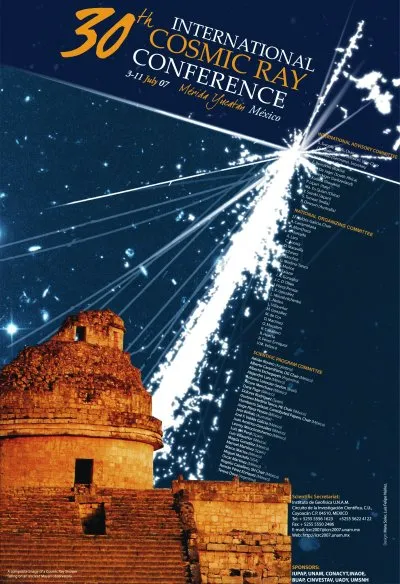
But T. Sloan of Lancaster University and A.W. Wolfendale of Durham University carefully examined the evidence and found it dubious. They published their results in a new paper called Cosmic Rays and Global Warming. Their research will be presented at the 30th International Cosmic Ray Conference in Mérida, Mexico between July 3 and 11.
According to the scientists, the 2000 paper that reflected the connection between cosmic rays and low-level clouds completely avoids clouds at other latitudes. This is surprising because the ionization from the rays should increase with altitude. Cosmic rays should be intercepted earlier by the atmosphere and turn towards clouds, not down to lower latitudes. If the rays were the culprits, exactly the opposite would be expected, with higher altitude clouds.
The next piece of skeptical evidence is the probability that cosmic rays create ions that become water droplets. The researchers estimated the density of cloud droplets that could be produced by cosmic rays at the lowest latitudes. They found that the ion production rate was too low to generate the number of water droplets required to create clouds.
On the other hand, if global warming were produced by cosmic rays, the ionized particles should affect the poles more, which is where they are directed and the reason why auroras form. This is not the case; in fact, the opposite is true.
Furthermore, it is known that there is a delay of 6-14 months between the decline in cosmic ray activity and the increase in the number of sunspots. Based on these cycles, the researchers found no correlation between the increase and decrease of sunspots and cloud cover levels. They estimate that less than 15% of the variations in the 11-year solar cycle are due to cosmic rays and less than 2% of the warming in the last 35 years is due to this cause.
If scientists wanted to study the interaction between radiation and cloud cover, they could conduct a large, unethical experiment: launch a tremendous amount of radiation into the atmosphere and see what happens to the environment's clouds.
Unfortunately, the experiment has already been performed... accidentally: the Chernobyl disaster.
On April 26, 1986, the reactor released an enormous cloud of radioactive particles into the atmosphere. If radiation increases cloud cover, there should have been clouds around the facility for weeks. There was no evidence of unusual cloud cover around it after the disaster.
Finally, it should be said that the issue has already moved into the political (and economic) sphere, so no evidence that is achieved will ever be sufficient, either to support one thesis or to uphold another.
But the consequences are in plain sight. And it very much feels like "blaming" natural phenomena exclusively, in this case astronomical phenomena, is rather an excuse not to take the necessary actions to stop the pollution generated by industries and the economic powers this implies.
Sources and related links
- Wired Science:No Link Between Cosmic Rays and Global Warming by Fraser Cain
- Bad Astronomy:Cosmic Rays and global warming
- RealClimate.org:‘Cosmoclimatology’ - tired old arguments in new clothes