A unique discovery of two cosmic explosions in the same position in the sky suggests to astronomers that they have witnessed the death of one of the most massive stars. An international collaboration of scientists, led by a team from the University of Belfast, joined Japanese supernova hunter Koichi Itagaki to report an incredible new discovery in the June 14 issue of Nature. This would be the first time a double explosion has been observed and challenges our understanding of stellar deaths.
Photos of galaxy UGC4904 at two different epochs. In 2004 a luminous object makes its appearance. In 2006 it reappears with much greater luminosity than the entire galaxy.
Via EurekAlert
In 2004 Koichi Itagaki discovered an exploding star in galaxy UGC 4904 (78 million light-years away in the constellation Lynx), which quickly faded away within 10 days. He did not formally announce it to the community, but later found a much brighter explosion in the same place but two years later, in 2006. Astronomers Prof. Stephen Smartt and Dr. Andrea Pastorello immediately realized the implications of finding two explosions in the same position in the sky.
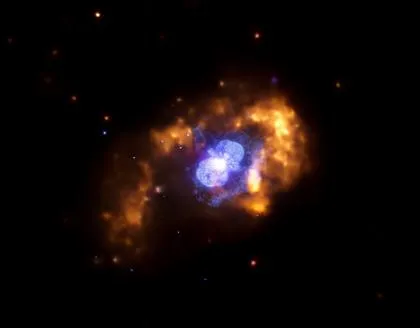
They began observing the supernova (named SN2006jc) in 2006 with large telescopes and analyzed Itagaki's images to show that the two explosions were exactly in the same place. The best explanation for the 2004 explosion was a probable outburst of a very massive star, like Eta-Carinae, on which a similar outburst had been observed in the 1850s. The 2006 supernova would be the final death of the same star.
Dr. Pastorello said "We knew the 2004 explosion could be a giant outburst from a very massive star, and we know that only the most massive stars can produce this type of outburst. So the 2006 supernova must have been the death of the same star, possibly a star between 50 to 100 times more massive than the Sun. And it seems that SN2006jc is a very rare supernova, unusually rich in helium, which supports our idea of an outburst and then death of a giant star".
Dr. Pastorello used British telescopes in La Palma (the Liverpool and William Herschel telescopes) in a combination of European and Asian efforts to monitor the supernova. He showed that the star must have been of the Wolf-Rayet type, which are the carbon-oxygen remnants of very massive stars.
Although it is the first time two coincident explosions of this type have been observed, they could be more frequent than thought. The future Pan-STARRS project, a new telescope with the world's largest digital camera, which will be able to study the entire sky once a week, could search for these peculiar supernovae.
Related Links
Paper:
A giant outburst two years before the core-collapse of a massive star
Published in Nature 14 juin 2007, vol. 447, n°. 7146
Authors: A. Pastorell, S. J. Smartt, S. Mattila, J. J. Eldridge, D. Young, K. Itagaki, H. Yamaoka, H. Navasardyan, S. Valenti, F. Patat, I. Agnoletto, T. Augusteijn, S. Benetti, E. Cappellaro, T. Boles, J.-M. Bonnet-Bidaud, M.T. Botticella, F. Bufano, C. Cao, J. Deng, M. Dennefeld, N. Elias-Rosa, A. Harutyunyan, F. P. Keenan, T. Iijima, V. Lorenzi, P. A. Mazzali, X. Meng, S. Nakano, T.B. Nielsen, J. V. Smoker, V. Stanishev, M. Turatto, D. Xu, L. Zampierio
Images of Eta-Carinae on HubbleSite
Press release and images at DSN DAPNIA