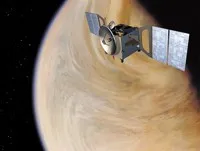
Today, two and a half years after the historic descent of the ESA's Huygens probe on Titan, a new set of results obtained on Saturn's largest moon is ready for presentation. Titan, through the eyes of Huygens, still holds exciting surprises for us, scientists affirm.
Via ESA
On January 14, 2005, the ESA's Huygens probe spent 2 hours and 28 minutes descending by parachute to land on Titan. It then transmitted for 70 minutes from the surface, until the Cassini spacecraft went out of coverage.
On December 8 of that same year, a group of scientists jointly published their first findings in the journal Nature. Currently, after another year and a half of patient work, they are now ready to add new details to the picture of Titan.
By using computer models of Titan, which are fed with data sent by the probe, planetary scientists have visualized Titan as a world in action, very similar to Earth in many aspects.
Huygens discovered that the atmosphere was hazier than expected, due to the presence of dust particles called 'aerosols'. Scientists are learning to interpret the analyses of these aerosols thanks to the use of a special camera that simulates Titan's atmosphere.
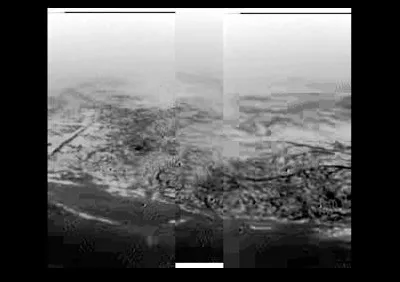
Once the probe descended below 40 kilometers in altitude, the haze dissipated and the cameras managed to capture the first sharp images of the surface. They revealed an extraordinary landscape, with clear evidence that a liquid, perhaps methane, had flowed over the surface causing erosion. Now, images from the Cassini spacecraft are being complemented with the 'ground truth' exposed by Huygens, in order to investigate how Titan's conditions have carved that landscape.
As the probe descended, Titan's winds swept it over the surface. Taking the winds as a reference, a new model of Titan's atmosphere has been created that reveals it as a giant conveyor belt, circulating gas from the south pole to the north pole and back.
Furthermore, the probable detection of a very low frequency (ELF) radio wave has piqued the curiosity of planetary scientists. If they confirm it is a natural phenomenon, it would allow them to probe the moon's subsurface and perhaps discover the presence of an underground ocean.
Huygens's journey to the surface is the subject of the most intense scrutiny, with much documentation generated about it. When an anomaly recorded on board the Cassini spacecraft caused scientists to lose data from the Doppler Wind Experiment (DWE), they had to perform a laborious analysis of the data collected by ground-based radio telescopes tracking Huygens's trajectory. Engineers and scientists managed to recover the probe's motion and produce a precise wind profile, which allowed them to place some of the data and images received from Huygens in the correct context.
Corroborating the evidence obtained so far, after the detailed analysis of many instruments and technical sensors on Huygens, unprecedented details are being added to the probe's motion during its descent.