Today, the ESA's Messenger and Venus Express spacecraft will fly over the planet together, giving scientists an opportunity to view our neighbor from two points of view.
Via UniverseToday
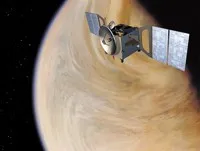
Illustration of Venus Express. Credits: ESA/Medialab
Venus Express has been orbiting the planet it owes its name to since April 11, 2006, but Messenger is passing by on its route to Mercury. And that's not all. Several telescopes will join the party taking images and data during the spacecraft's flyby.
Messenger -which in Spanish means Messenger- is the acronym for MErcury Surface Space ENvironment GEochemistry and Ranging mission, that is, Mission for distance measurement and geochemistry of the environment of Mercury's surface.
At its closest approach Messenger will pass only 337 kilometers above the surface of Venus. And during that time, the Express spacecraft will be behind the planet but will be able to see many of the same regions captured by the "messenger" spacecraft. Scientists will then be able to compare the data from the two spacecraft.
The spacecraft will perform observations and measurements of the planet's cloud cover, plasma environment, atmosphere, and surface oxygen.
At its closest approach, Messenger will perform measurements of the cloud cover with its laser altimeter instrument (MLA). This will complement the cloud data obtained by Express in the visible, ultraviolet, and infrared spectrum.
Both spacecraft will also obtain joint information about the dynamics of the Venusian atmosphere. In this task, the telescope at the Observatoire de Haute-Provence in France will also join, which will also measure the planet's winds.
This campaign will include complementary observations of the oxygen "airglow".
The airglow is the nightglow, sometimes called permanent aurora. It is the almost permanent emission of radiation from the upper atmosphere over middle and low latitudes that is distinct from the sporadic emission of auroras at high latitudes.
It is a photochemical luminescence from chemical reactions in the upper atmosphere. Many of these reactions leave molecules and atoms in excited states and radiate at certain specific wavelengths. Emissions of molecular oxygen (O2), atomic oxygen (O), Sodium (Na) and the hydroxyl radical (OH) are specifically prominent and measurements of the airglow intensity by spectroscopic techniques provide great information about the dynamics and chemistry of the upper atmosphere.
At the same time, the IRTF in Hawaii will observe the same phenomenon in infrared along with the Apache Point Observatory (APO), at visible wavelengths, and the W.M. Keck.
The study of plasma will benefit from the passage of both spacecraft.
Plasma -a gas of diffuse charged particles in space and strongly influenced by solar activity- is a very complex state of matter. It has very low density but its distribution scale around planets is enormous. Having a multi-point observation at Venus is a unique advantage that will help understand the behavior of plasma around the planet.
After 30 hours of observation, Messenger will focus again on its final target. It would arrive at the planet closest to the Sun, Mercury, in March 2011.
ESA press release
Venus Flyby at Ciencia@Nasa