Imagine the following: Two robots float together in space, nose to nose. One of them extends a curved silver arm and begins to attend to the other's needs. Fuel is exchanged and a battery is replaced; maintenance completed, the two silently separate. These robots, called ASTRO and NextSat, are real and are in Earth orbit right now.
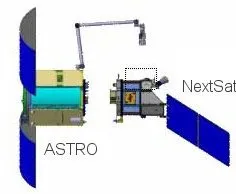
Artist's concept of ASTRO, the Autonomous Space Transport Robotic Operations servicing vehicle (left) and NextSat, the next-generation satellite that can receive on-orbit maintenance (right).
On March 8, 2007, an Atlas V rocket propelled the pair of robots into space. Their mission: to demonstrate autonomous satellite servicing capabilities in orbit, a vital technology for the future of space exploration. The Defense Advanced Research Projects Agency (DARPA) directs the project, named Orbital Express.
ASTRO and NextSat look more like common satellites than high-tech robots, but they are far from common. ASTRO, in particular, seems to have a mind of its own, able to approach NextSat and dock with it. Likewise, ASTRO has its own arm to reach the target, perform maneuvers, and carry out maintenance work—tasks previously reserved for the hands of astronauts. NextSat plays a less glamorous but no less essential role as it orbits Earth, making itself available to ASTRO for any test ordered by controllers on Earth.
All of this is new, and indeed, controllers located on Earth are proceeding cautiously to see what ASTRO can really do.
The first on-orbit test was carried out in April. The two satellites remained safely docked while ASTRO's mechanical arm performed tasks on NextSat, moving it into various positions to calibrate range and docking sensors. ASTRO also transferred fuel and a battery to NextSat. Score: A+.
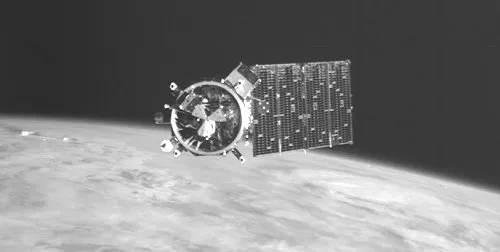
NextSat, photographed by ASTRO while the pair of robots flew in formation, on May 5, 2007.
The next major test took place on May 5. ASTRO and NextSat fully undocked and flew in perfect formation for about 90 minutes. The distance between the two during this maneuver was around 10 meters. Then ASTRO approached and reunited with NextSat, thus performing the first automated rendezvous and docking in the history of the U.S. space program! This test also included an autonomous fuel transfer.
The milestone was possible thanks to ASTRO's Advanced Video Guidance Sensor (AVGS), an instrument developed at the Marshall Space Flight Center. This is one of the key technologies that give ASTRO "a mind of its own."
ASTRO needed all the intelligence it could muster in mid-May, when something unexpected happened. A failure in ASTRO's flight computer caused the cancellation of a docking test at 10 meters from its target, before the vehicles docked again. Over the following days, ASTRO and NextSat separated by more than 6 kilometers (practically 4 miles)! On May 19, at an approximate distance of 150 meters—greater than any distance tested on Earth for the Orbital Express mission—the AVGS instrument locked on and began tracking NextSat. Disaster averted.
"The AVGS instrument was very useful in reuniting the two spacecraft," commented Fred Kennedy, the program director at DARPA. "Our mission operations team spent long days diagnosing sensor and navigation anomalies and was finally able to manually relocate the ASTRO satellite to less than a kilometer away from NextSat. Then it was just a matter of returning attitude control to ASTRO, which performed a series of autonomous maneuvers to place us within the fully operational range of the AVGS and then the two spacecraft could connect again."
This unplanned test may have been the most valuable of all, and demonstrated that ASTRO and NextSat are capable of dealing with the unexpected and operating beyond their theoretical limits.
The mission is now coming to an end after establishing several milestones in U.S. space history. In addition to the first automated rendezvous and docking performed by the United States, ASTRO and NextSat also performed the first fully autonomous circular flight and docking, plus an exciting free-flight capture of NextSat using ASTRO's robotic arm.
All of this goes to show that automated rendezvous and maintenance can be a realistic option for future space missions. In fact, technologies tested by the Orbital Express mission could revolutionize the way space is explored, making it possible within the next decade to carry out refueling and repair tasks on spacecraft without the intervention of human hands. This, in turn, will give humans more freedom to perform work that only people can do.
It's a partnership: ASTRO and NextSat, humans and machines, together in the void.
Sources and related links
- Note on Science@NASA
- ASTRO and NextSat Say Goodbye After Fulfilling Their Duty
- Look Ma, No (Human) Hands!