Saturn's distinctive moon is cryogenically frozen in the equivalent of its teenage years, a relic from when the solar system was young.
These results appear in the online version of the journal Icarus.
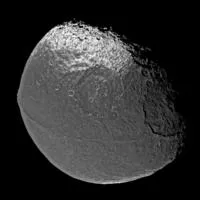
The Cassini spacecraft flew by the moon in 2005 and discovered it has a walnut shape, bulging in its middle region. On that region it has a mountain range exactly along its equator.
"We have modeled how Iapetus formed its large bulge and why its rotation slowed to its current period of nearly 80 days. As an unexpected bonus, Iapetus told us how old it was," says Dennis Matson, Cassini project scientist at JPL. "You would expect a moon with a fast spin to have that bulge, but not one with a slow spin, because the bulge would have to have been much flatter."
Scientists calculate that it originally rotated much faster - at least 5 hours, but less than 16 per revolution. The rapid rotation gave the moon an oval shape that increased its surface area. Over time the rotation slowed to a period of 16 hours and the moon's outer shell froze. Moreover, the cold moon's surface area is now smaller. The excess surface material was too rigid to smoothly recede back toward the moon. Instead, it piled up into a mountain range at the equator.
For forces to slow the moon to its current rotation, its interior would have to be much warmer, close to the melting point of water ice.
After considering several models, scientists concluded that the heat came from its rocks, which contain short-lived radioactive isotopes of iron-60 and aluminum-26. Since these elements decay over a known time, it allows scientists to estimate the moon's age. Calculations indicate Iapetus is approximately 4,564 million years old.
Evidence of these same isotopes has been found in meteorites formed in the inner solar system. Therefore, there is a possibility to compare the early chronology of the outer solar system with other inner objects, like Earth, the Moon, and asteroids.
Cassini's next close encounter with Iapetus will occur on September 10 of this year, at one thousand kilometers from its surface.
Sources and related links
- Note on the Cassini page
- Note on Physorg
- Paper: Iapetus' geophysics: Rotation rate, shape, and equatorial ridge; Received 23 July 2006; revised 30 January 2007. Available online 28 March 2007.