The X-ray orbital telescopes Chandra and XMM-Newton have captured a pair of galaxy clusters merging into a giant one. The discovery adds to the evidence that galaxy clusters can collide faster than previously thought.
Renato Dupke and colleagues from the University of Michigan, Ann Arbor, used the ESA's X-ray observatories to unravel the galaxy cluster Abell 576.
Previous observations gave clues that the gas was not moving uniformly through the cluster. Using the sensitivity and resolution of the European agency's orbital observatories, Dupke took readings from two locations in the cluster and saw that there was a distinctive difference in the gas's velocity. One part of the cluster seemed to be moving away from us faster than the other.
The problem was that the moving gas was cold by astronomical standards. If the gas was moving at such speeds, it should have a temperature more than double the measured one.
"The only explanation was to take the Bullet cluster and put it in the line of sight, so one cluster is directly behind the other," says Dupke.
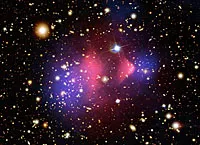
The Bullet cluster is a pair of clusters that have collided, the most studied. One cluster has passed through the other, like a bullet traveling through an apple. In the Bullet cluster that is happening across our line of sight, so we can see them clearly.
Dupke realized that Abell 576 is also a collision, but seen head-on, so one cluster is almost directly behind the other. The "cold" gas clouds are the cores of each cluster, which have survived the initial collision but will eventually merge into one.
The data reveal that the clusters have collided at a speed of 3300 km/s. This is interesting because there are some computational models of colliding clusters that suggest such speeds are impossible to reach.
However, the Bullet cluster is estimated to have collided at a similar speed. "There is now a growing body of evidence that these high collision speeds are possible," says Dupke. The work of explaining these speeds now falls to the cosmologists.
Large cluster collisions are expected to be rare, estimated between less than one in a thousand clusters to one in a hundred.
In collisions, the internal gas becomes unbalanced and if not recognized causes an underestimation of its mass between 5 and 20 percent. This is important because the masses of various clusters are used to estimate cosmological parameters that describe how our universe expands. Therefore, identifying colliding systems becomes very important.
Dupke and his colleagues are investigating several other clusters that also appear to be interacting.
The discoveries appear in the paper: 'The merger in Abell 576: a line of sight bullet cluster?', by R. A. Dupke, N. Mirabal, J. N. Bregman & A. E. Evrard, accepted for publication in Astrophysical Journal.
Sources and related links
- ESA press release
- Abell Catalog of Galaxy Clusters