A note from La Nación about the city of Malargüe, which is turning 56 and is home to the Pierre Auger Observatory.
The largest astrophysical project added its last observatory: It will try to elucidate what high-energy cosmic rays are and where they come from
MALARGÜE.- For many, Mendoza is synonymous with sun and good wine. But just take the route south and travel about four hundred kilometers -most of it crossing a desert covered with sparse, thorny bushes- to encounter a different reality. In this small city of less than twenty thousand inhabitants, which turns 56 tomorrow, one of the most ambitious projects in current cosmology is nearing completion: the Pierre Auger Cosmic Ray Observatory, an international collaboration of 30 scientific institutions from 15 countries that tries to find out where particles of incredible energy that come from space and constantly bombard Earth from all directions come from. No known source in the cosmos can produce them, not even the most violent star explosions.
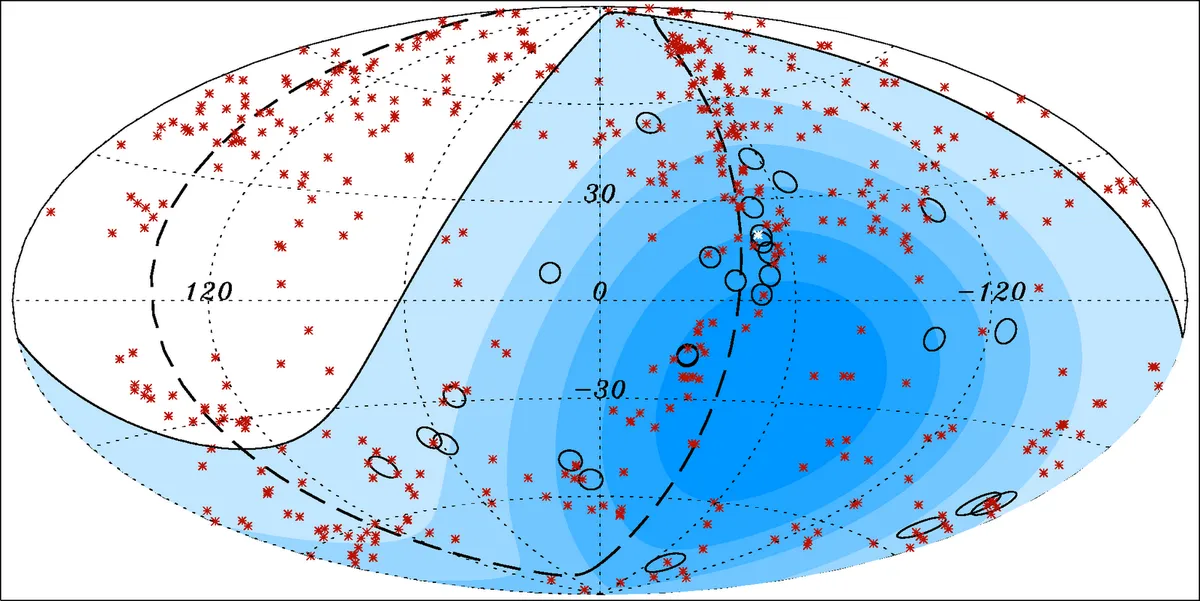
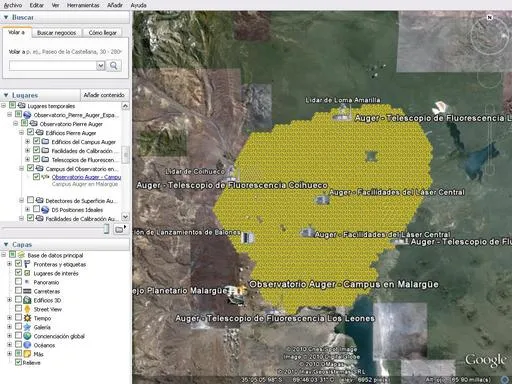
These mysterious cosmic rays travel at a speed close to that of light and have hundreds of millions of times more energy than particles produced by any of today's accelerators. They can be detected by observing the "showers" that occur when one of those particles collides with an air molecule. But since the events of interest (the very high-energy ones) are scarce -barely one per century per square kilometer-, the Pierre Auger requires twenty-four optical telescopes distributed in four buildings and 1600 detectors scattered over an area four times larger than the city of Buenos Aires.
The "brain" of this complex is steps away from the center of Malargüe, on the wide main avenue lined with low houses that protect themselves from the wind with curtains of white poplars. As soon as you pass through the glass doors, you enter a first-world scientific center, with groups of researchers -each focused on their notebook connected to high-speed Internet- speaking in half a dozen different languages. They say that, since construction began about six years ago, it has been changing the city's appearance. Throughout this time, the center has received 5800 visitors, but researchers are also supervising the construction of what will likely be the country's first digital planetarium. Under the influence of this project, scientific tourism is growing, Malargüe children are studying English, and there are already plans for the installation of an Italian volcanology center.
The scientists integrate into the city, and the city feels proud of "its" researchers. As Dr. Alberto Etchegoyen, director of the southern observatory, points out, there are no longer ivory towers here.
MALARGÜE, Mendoza.- In Loma Amarilla, on a stony plateau that stretches to the horizon and tens of kilometers from any inhabited site, stands an intriguing building: it houses the large chamber containing six huge fluorescence telescopes capable of detecting the glow of a four-watt light bulb 30 kilometers away moving at the speed of light.
It was inaugurated yesterday and is the fourth and last in the series that makes up the world's largest astrophysical experiment, the Pierre Auger Cosmic Ray Observatory, which scatters its detectors over an area of 3000 square kilometers.
"It is a gigantic project, with 250 scientists and the world's largest experimental station -says Alberto Etchegoyen, a physicist at the Comisión Nacional de Energía Atómica (CNEA) and director of the southern observatory-. It also has the largest private wireless communication network on the planet."
As could not be otherwise, the mood was one of contagious enthusiasm: not every day is a cyclopean work like this completed in the country. And the feat takes on almost miraculous proportions considering that this international project, approved in 1995 by UNESCO, had to weather the violent economic and institutional storm of 2001.
That explains why there were nothing but smiles of satisfaction among the researchers who came from fifteen countries; the governor of Mendoza, engineer Julio Cobos, who oversaw the construction; the vice president and research manager of CNEA, which is in charge of the project in Argentina, doctors Carlos Rey and Alberto Lamagna, respectively, among others.
"It's a doubly beautiful day for what we are achieving -exclaimed Nobel laureate James Cronin, emeritus director-. We have data, we are analyzing it, and there are many interesting points. In a year we will be publishing what the spectrum of cosmic rays is, their composition, whether they are heavy nuclei or protons... But we don't want to rush, because there are so many scientists eager to get results all over the world that we have to be very cautious." And he immediately adds: "It is very, very stimulating. The observatory's performance is even better than we expected. I have never had an experience like this before."
Fast particles
The Auger project tries to find out what these cosmic rays are and what their source is, the fastest particles in the universe and with an energy a hundred million times greater than what human technology can produce. To find out, scientists will use 27 fluorescence telescopes and 1660 tanks with hyperpure water and detectors capable of recording their fleeting passage through the atmosphere.
Although it is estimated that the answer to some of the questions researchers ask will require fifteen or twenty years of data collection, there are already clues. "This is like a puzzle: as the pieces are placed, you can already work, because the detectors function independently -says the scientist-. Progress is being made and the pioneering group is from the Bariloche Atomic Center. The results are very encouraging. In two years we will know if we can do 'charged particle' astronomy, a new area of human knowledge. That, if everything goes well and nature helps us."
The observatory inaugurated yesterday is a feat of technology. Operated remotely, it only opens its windows on very clear, moonless nights. "It will house concave mirrors of polished glass made in the Czech Republic, of eleven square meters, whose mission is to detect the ultraviolet fluorescence light originating from the cascade of particles produced when a cosmic ray strikes the upper atmosphere -explains Dr. Ingo Allekotte, in charge of the surface detectors, from the Bariloche Atomic Center-. The mirrors concentrate the light onto a camera of 440 exquisitely sensitive phototubes. When one of these events occurs, the observatory's nervous system records it and sends the information to the central brain located in the Malargüe Center. Scientists from all over the world access it via the Internet to analyze the data. The same information is recorded by the tanks with detectors scattered across Pampa Amarilla. They are two complementary detection systems that allow for cross-calibration."
"The scientists here are fantastic. The University of La Plata, the Bariloche Atomic Center and so many other physicists who have done a phenomenal job were central to carrying out the project," says Cronin.
-Do you regret having chosen Argentina to develop the Pierre Auger Observatory?
-No, no! This is a beautiful place and the Argentines have fulfilled their commitment. Even in difficult times. I feel very proud.
By Nora Bär
See explanatory pdf published by Iciencia