The James Webb Space Telescope will be the largest ever built. Its success requires incessant work, day and night, seven days a week, until its launch date, in the year 2013.
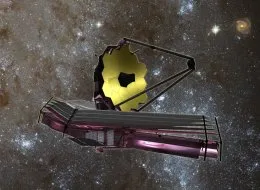
Artist's concept of the James Webb Space Telescope. NASA
August 10, 2007: The road to the Marshall Space Flight Center is very dark at 3:30 in the morning. There is no urban lighting or buildings on this long rural road. Only the glowing eyes of skunks and raccoons peek out from the dense pine foliage. Once you arrive at the Marshall complex, the buildings are also dark, except for one — the X-Ray Calibration Facility (XRCF). Here, the lights stay on all night and some people consider it their home.
Barry Hale (lead technician) and Jay Carpenter (plant engineer) are working the night shift. At least two people must attend these facilities every night, monitoring screens on a long panel located in the control room. Twelve people have been rotating shifts 24 hours a day, seven days a week, since the end of May.
"Why have all these people become night owls?" Because the success of NASA's next great space telescope depends on it: "We are testing the James Webb Space Telescope (JWST)," explains Jeff Kegley, team leader at the XRCF.
Scheduled for launch in 2013, the Webb telescope is widely recognized as the most important telescope of the next decade. It is an infrared telescope, which means it can detect the heat of stars and galaxies located millions, and even billions, of light-years away. To capture those incredibly faint heat signals, the telescope must be kept extraordinarily cold — and that is why everyone stays watching the monitors.
The Webb telescope will operate in space at a temperature of -238 degrees Celsius (-396 degrees Fahrenheit). Such extreme cold can cause the telescope's structures and mirrors to change shape. To prevent that from happening, the telescope is being tested at the XRCF, piece by piece, inside a vacuum chamber that simulates the extreme cold of space. The results reveal any distortion that occurs in the components, so that changes can be made, if necessary.
But there is much more to do during the night shifts, not just watching monitors with test data on the control panel. Like most night staff, Hale and Carpenter make "rounds." These rounds include going out to check the "nitrogen farm," where monumental white tanks of liquid nitrogen lie in the darkness like dairy cows in a pasture. The nitrogen is used to cool the vacuum chamber where the components are tested and the men check for leaks in the tanks, every night.
Hale and Carpenter have also seen some real animals on the farm. One night, Hale had a close encounter of the "brusque kind" with a skunk — which gives new meaning to the concept of doing "skunk work."
While making these "dangerous" surveillance rounds, and while watching the control room screens, the night shift team ensures that equipment pressures, flow rates, temperatures, and valve positions remain within the appropriate ranges for the tests. They also manipulate the helium refrigeration systems, the vacuum chamber pressure, and the liquid nitrogen zones so that the vacuum chamber keeps the test article within a particular test profile.
"The test article for tonight is a section of the 'Bread Box' of the ISIM," says Carpenter. "That's what we call the support structure of the Integrated Science Instrument Module (ISIM) that holds the telescope's four main scientific instruments." (The instrument names are: the Mid-Infrared Instrument, the Near-Infrared Camera, the Near-Infrared Spectrograph, and the Fine Guidance Sensor.)
While the "Bread Box," located in the test chamber, undergoes a temperature transition, from room temperature to -233 degrees Celsius (-387 degrees Fahrenheit), an Electronic Speckle Pattern Interferometer optically measures structural distortion. No, it's not a strange salamander, but a rare instrument. "This is one of only two instantaneous phase-shift speckle interferometers," says Joseph Geary of the University of Alabama in Huntsville, who, incidentally, is also working precisely today on the night shift. The interferometer is being used to detect thermal distortions of just a few nanometers (a nanometer is one billionth of a meter) in the "Bread Box."
In a few days, after the "Bread Box" tests are finished, the staff will reconfigure the facilities to perform verification tests on the segmented mirrors. The Webb telescope is composed of 18 individual mirrors that will form a mirror group 6.5 meters in diameter. In the spring, engineers will begin testing related to the optical quality of each segmented mirror. The tests, which are conducted 24 hours a day, will continue until the year 2010. That's a lot of tests, a lot of night shifts, and a lot of skunks.
Carpenter comments that he doesn't really mind working nights, but says "it's a bit hard for my family to stay quiet during the day so I can sleep. My granddaughter wants to play, but she's not allowed to knock on my door. It's a bit hard for me too."
Kegley says he likes working the night shift occasionally because it's a good opportunity to get ahead on work. "There aren't as many calls or emails interrupting you at 3 in the morning."
Sources and related links
Note at Ciencia@NASA