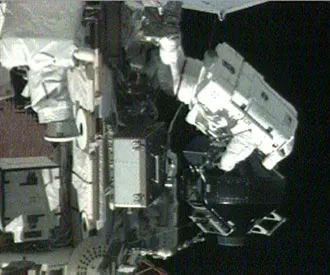
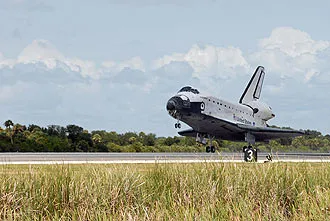
The US space shuttle Endeavour docked yesterday with the International Space Station (ISS) at 18:02 GMT, after two days of travel. During liftoff, nine small pieces of foam insulation came off the shuttle's 50-meter-high external tank, three of which struck the Endeavour.
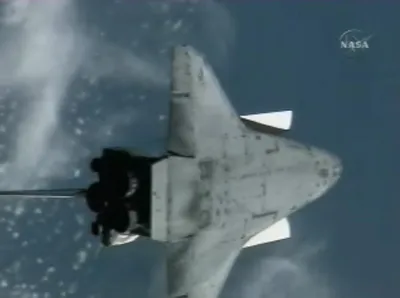
Endeavour's "backflip". Credit: NASA TV.
About two hours later, the hatch between the shuttle and the ISS was opened. The crew members of Endeavour boarded the ISS, where they hugged the station's crew and took photos.
Before the docking maneuver, Endeavour performed a backflip 120 meters from the ISS. During the nine-minute space acrobatics, the three ISS crew members photographed the shuttle's thermal shield with 400 and 800 millimeter lenses.
In this way, the US Space Agency (NASA) wants to verify possible damage to Endeavour.
A piece of foam that came off during liftoff and damaged the shuttle caused the Columbia tragedy on February 1, 2003, in which the seven astronauts died, which is why this issue will be checked with special care.
Like the Atlantis flight two months ago, this flight also did not proceed without problems.
The five men and two women on board will have to organize a sort of shift schedule for the next two weeks. Since a sensor to control pressure broke, the astronauts will have to, according to flight director Matt Abbott, move a switch every 30 to 45 minutes to maintain the necessary pressure in a tank with liquid hydrogen and oxygen that feed the generators.
This new mission to continue expanding the construction of the ISS will last 11 to 14 days and its power system.
The astronauts will have to install a connecting piece to which another segment with new solar panels will later be attached.
When the new power system on the ISS is operational, Endeavour will be the first shuttle that can stay three more days in space.
The thermal protection of the US space shuttle Endeavour was apparently damaged by the impact of a piece of ice shortly after liftoff, but the magnitude of the problem has not yet been determined, a NASA official reported this Friday.
"It looks like the impact of a piece of ice," said John Shannon, the mission manager, at a press conference. "I still don't know what that could mean for the mission," he added.
Shannon specified that an inspection with the help of a camera is scheduled for Sunday to assess the magnitude of the damage, particularly its depth.
An analysis performed by radar showed that one of the fragments that came off 58 seconds after launch on Wednesday and that damaged a thermal layer on the shuttle's belly was a piece of ice and not of the insulating foam, explained the NASA official.
Sources and related links
- Note in NYTimes
- Note in Space.com
- Note in La Nación