The largest known cluster of red supergiant stars has been found near the central bulge of our galaxy and offers a rare glimpse of massive stars on the verge of explosion.
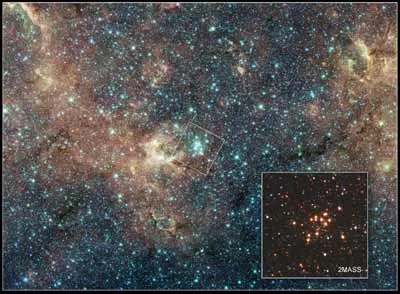
Image composition of the cluster with 14 supergiants. Credit: Spitzer, Don Figer.
Red supergiants are some of the largest stars in the universe; in fact, they are only surpassed by hypergiants like Eta Carinae.
These stellar titans are extremely rare. Only very massive stars, more than 10 times larger than our Sun, become this type of object. The supergiant stage lasts only about 100,000 years before ending in a supernova.
Only about 200 red supergiants have been identified in our galaxy. In 2006, a team led by Don Figer of the Rochester Institute of Technology (RIT) reported having found a massive cluster of hundreds of stars that included 14 supergiants, the largest collection of this rare type of star.
Now, Ben Davies, also from RIT, and a team that includes Figer have identified an even larger group of 26 red supergiants.
The cluster, detected by the Keck II telescope, was named RSGC2 and contains about 50,000 stars in total, making it one of the most massive clusters of young stars in the galaxy. The team thinks the cluster is less than 20 million years old.
The masses of the supergiants in the cluster are uncertain, but their brightness is 300,000 times as luminous as the Sun.
RSGC2 was found only a few light-years away from the one found in 2006, called RSGC1, and both are similar in age.
The proximity of the clusters is probably not a coincidence, according to Davies. According to the scientist, there are other signs of copious star formation in the neighborhood, a region where one of the galaxy's spiral arms, called Scutum-Crux, meets the galaxy's central bulge.
The two clusters provide a rare opportunity to study the properties of stars that are very close to exploding.
Sources and related links
- Note in Newscientist
- Paper: A massive cluster of Red Supergiants at the base of the Scutum-Crux arm