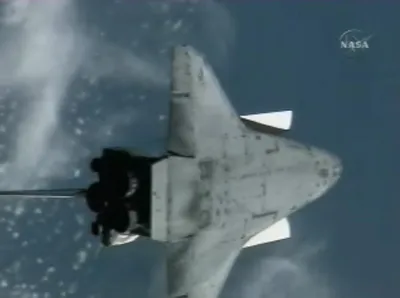
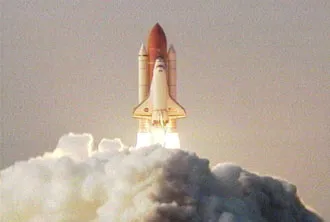
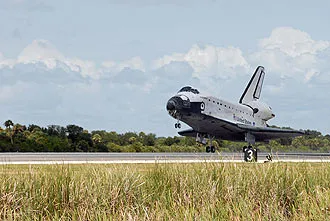
A piece of insulating foam struck the shuttle during liftoff last week and produced a 7.6-centimeter crack in its belly
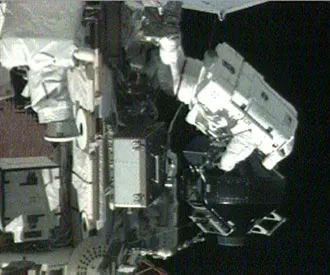
Rick Mastracchio holds the CMG removed from the T1 segment. NASA TV
Two astronauts performed an EVA to replace equipment on the international station, while NASA debated whether the Endeavour crew should perform a series of risky repairs to close a crack in the shuttle's belly.
A piece of insulating foam struck Endeavour during liftoff, creating a 3.5-inch hole (about 7.5 centimeters) in the thermal shield on the craft's belly.
Barbara Morgan and other crew members spent most of Sunday using a laser crane mounted on the shuttle's robot arm to create three-dimensional images of the hole and other damaged parts, which NASA officials say do not represent any threat.
Mission directors hoped to decide by Monday or Tuesday at the latest whether to send astronauts to repair the damaged parts. They are trying to determine if the damaged area can withstand the heat of reentry into the atmosphere at the end of the flight. Heat resistance tests will be conducted on similar damaged samples.
The shuttle Columbia was destroyed in 2003 upon reentering Earth when atmospheric gases entered a hole and melted the wing. The impact with a piece of insulating foam during liftoff had caused the hole.
Meanwhile, the second spacewalk of STS-118 will go down in the history books, according to NASA. Specialist Dave Williams and Rick Mastracchio successfully installed a new control moment gyroscope on the ISS.
The new CMG (control moment gyroscope) replaces a failed one that was removed during the first part of the spacewalk. The excursion lasted 6 hours, 28 minutes during which Tracy Caldwell was the coordinator and pilot Charles Hobaugh and Clay Anderson operated the robotic arm.
The astronauts planned to perform two more spacewalks on Wednesday and Friday, and could also carry out the repair tasks.
Sources and related links
Note in La Nación