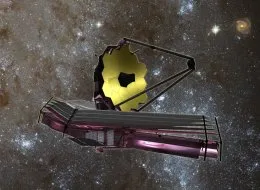
A giant telescope planned for construction in Chile hopes to find hundreds of thousands of developing galaxies in the early universe, illuminating the formation of the great galaxies in the modern cosmos.

The Cornell Caltech Atacama Telescope (CCAT) will observe at submillimeter wavelengths, which are part of the microwave portion of the electromagnetic spectrum. With its 25-meter antenna, the US$100 million telescope will be the largest in the world for submillimeter astronomy when completed, in 2013.
Submillimeter light is absorbed by water vapor in the atmosphere, so a clear view requires a location with the least amount of vapor above the telescope. The chosen site, in the busy Atacama Desert in Chile, is twice as dry as the summit of Mauna Kea in Hawaii.
The submillimeter part of the spectrum is "a new frontier that is relatively unexplored," says Gordon Stacey, a team member.
Since light takes time to travel because its speed is finite, telescopes can peer back in time by looking at distant objects. CCAT will discover up to a million galaxies seen as they were 10 billion years ago or more.
A huge number of galaxies with intense star formation seem to have been present in the early universe, but they are usually invisible to telescopes operating at other wavelengths because they are surrounded by dust. However, these galaxies emit strongly in submillimeter waves.
Furthermore, CCAT will be a powerful complement to an even more ambitious device under development, the Atacama Large Millimeter Array or ALMA. Each of the 64 antennas of ALMA will be smaller but linked together will be capable of seeing finer details than CCAT.
But CCAT's larger field of view means it can study the sky and find distant galaxies more quickly, while ALMA can be used to conduct more detailed studies.
Sources and related links
- Note on NewScientist.com
- http://www.submm.org/
- APEX