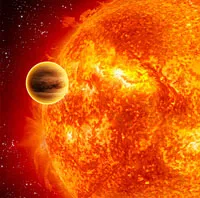
An international team of astronomers discovered a new planet in the constellation Hercules and it would be the largest known so far.
Furthermore, another team discovered a planet orbiting a red giant star.
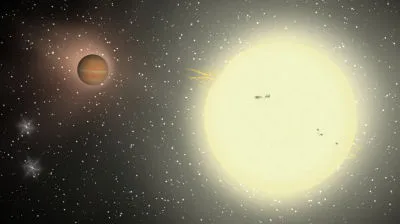
A team of astronomers from the Trans-atlantic Exoplanet Survey (TrES) study announced the discovery of TrES-4. The discovery occurred while searching for planets in transit, meaning they pass in front of their star, using a network of small automated telescopes in Arizona, California and the Canary Islands. The planet was discovered less than half a degree (close to the size of the full Moon) from the team's third planet TrES-3.
"TrES-4 is the largest known exoplanet" said Georgi Mandushev, of Lowell Observatory and author of the paper. "It is 70 percent larger than Jupiter, but less massive, making it a planet of extremely low density. This means its density is only 0.2 grams per cubic centimeter, or close to the density of balsa wood! And due to its relatively weak gravity in its upper atmosphere, part of its atmosphere probably escapes in the form of a comet tail".
The new planet was first noted by the Lowell Observatory's Planet Search Survey Telescope (PSST). TrES-4 is about 1400 light-years away and orbits its star in three and a half days. Being only 4.5 million miles from its star, the planet is very hot, about 1600 Kelvin.
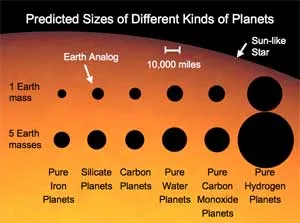
"TrES-4 appears to be a theoretical problem", says Edward Dunham, of Lowell Observatory. "It is larger in relation to its mass than what current models of super-hot planets can explain"
But not only is the planet mysterious, its star is too, cataloged as GSC 02620-00648. Georgi Mandushev explains:" The host star appears to be the same age as our Sun, but because it is more massive, it has evolved faster. It has become what astronomers call a subgiant on its way to being a red giant, like Arcturus or Aldebaran".
The paper accepted for publication in Astrophysical Journal is titled "TrES-4: A Transiting Hot Jupiter of Very Low Density".
An exoplanet around a red giant
A planet orbiting a red giant has been discovered by a team led by Alex Wolszczan, who in 1992 discovered the first planets outside the solar system. The new discovery helps astronomers understand what will happen to the planets in our system when our Sun becomes a red giant, expanding its surface to the orbit of Earth.
The star is twice as massive and 10 times larger than our Sun. The new planet orbits the star every 360 days and is located about 300 light-years from Earth, in the constellation Perseus.
The paper describing the finding will be published in November in the edition of Astrophysical Journal.
"This planet is the first discovered by Penn State astronomers with the Hobby-Eberly Telescope, and is one of the most distant of the 10 solar systems discovered around red giants", comments Lawrence Ramsey, a team member.
Sources and related links
- EurekAlert:Largest transiting extrasolar planet found around a distant star
- Press release from Lowell
- EurekAlert:Planet orbiting a giant red star discovered with Hobby-Eberly telescope
- Press release from Penn