A team of astronomers has created models for 14 different types of solid planets that could exist in our galaxy. The planets have various compositions, and the team calculated how large each should be for a given mass. Some are pure ice, carbon, iron, silicates, carbon monoxide, and silicon, others are mixtures of these components.
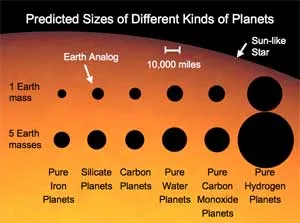
Illustration of planet size according to composition. Marc Kuchner/NASA GSFC.
"We are seriously thinking about the different types of Earth-sized planets that could be out there, like George Lucas, but for real," says Marc Kuchner of the Goddard Space Flight Center, alluding to the filmmaker's famous "Star Wars" saga, in which various types of planets are seen.
The team took a different approach from previous studies. Instead of assuming that planets around other stars are larger or smaller versions of the planets in our solar system, they considered all the types of planets that could be possible, given what is known about the composition of protoplanetary disks around young stars.
"We have learned that giant exoplanets differ tremendously from the worlds in our solar system, so we let our imagination run wild and tried to cover the options with our models of smaller planets. We can make educated guesses about these different types of planets. For example, carbon and carbon monoxide planets could be favored by evolved stars like white dwarfs and pulsars or could form in carbon-rich disks like the one around the star Beta Pictoris. But, ultimately, we need observations to give us answers."
The team calculated how gravity would compress planets of various compositions. The resulting computational models predict a planetary diameter for a given composition and mass. For example, a planet with Earth's mass, made of water, would be only 9,500 miles, while an iron planet with the same mass would be only 3,000 miles in diameter. In comparison, Earth, composed mostly of silicates, is 7,926 miles at its equator.
Some results were expected, such as the fact that a planet of pure water would be the least dense and those of pure iron the densest. But there were some surprises. The team found that regardless of the planet's material, the mass/diameter relationship follows a similar pattern.
"All materials compress in a similar way due to the structure of solids," explains Sara Seager. "If you squeeze a rock, nothing happens until you reach a critical pressure that breaks it. With planets it's the same, but they react to different pressures depending on the components. It's a big step in understanding planets."
Satellite missions, such as Corot, launched in December, and the upcoming Kepler planned for 2009, will be able to find planets no larger than Earth by seeing them pass in front of their host star, events known as transits. However, this technique alone does not allow distinguishing the planet's composition. For that, instruments like the James Webb Space Telescope will be needed, for example.
The paper will appear in the October 20 edition of Astrophysical Journal.
Sources and related links
- Note on Physorg
- Press release at Goddard Space Flight Center