Scientists have reported the first conclusive discovery of the presence of water vapor in the atmosphere of a planet located outside the Solar System.
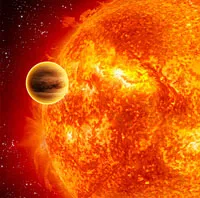
Illustration of exoplanet HD 189733b. Credit:ESA - C.Carreau
Observations in infrared light of the passage of the gaseous giant planet in front of its star allowed the surprising data to be obtained.
Giovanna Tinetti, an ESA member at the Institute d’Astrophysique de Paris, along with colleagues from other parts of the world, used data provided by NASA's Spitzer space telescope. They targeted the planet HD 189733b, located 63 light-years away in the constellation Vulpecula.
The planet was discovered in 2005 by dimming the light of its star by three percent when it passed in front of it. Tinetti and the team used Spitzer to observe the star, which has a slightly fainter light than the Sun's. They noted that its light dimmed in two infrared bands (3.6 and 5.8 micrometers).
If the planet had been a rocky body without an atmosphere, the two bands and a third one (8 micrometers), recently measured by a group of professionals from Harvard, would have behaved the same way.
However, when the planet's tenuous outer atmosphere moved in front of the star, the absorbed starlight showed a clearly distinct pattern. The atmosphere absorbed less infrared radiation at 3.6 micrometers than at the other two wavelengths.
"Water is the only molecule that can explain that behavior," says Tinetti.
The presence of water vapor does not necessarily imply the existence of life. "It is a world that is far from being habitable," she states.
HD 189733b is not a rocky world like Earth, and it is very large, having about 1.15 times the mass of Jupiter. Located only 4.5 million km from its star, it orbits it every 2.2 days. In comparison, Earth is 150 million km from the Sun, and even Mercury, the planet closest to it, is 70 million km away.
Astronomers classify that type of world as 'hot Jupiters'. They are planets that usually have vast atmospheres because the nearby star provides them with energy for expansion. HD 189733b is no exception; its diameter is 1.25 times that of Jupiter.
The atmospheric temperature of HD 189733b is about 1,000 degrees Kelvin (a little over 700 °C) or higher, so the large amount of water vapor present in the atmosphere cannot condense to fall as rain or form clouds. The temperature would have to be about five times colder for the water vapor to turn into clouds or rain.
However, this does not mean the atmosphere is serene. The planet is so firmly gripped by its star's gravity that the same hemisphere is always facing it, so only one side heats up. This likely generates ferocious winds blowing from the day side to the night side. "There are thousands of things we don't know about this type of planet," comments Tinetti.
Although being a gas giant the planet is ruled out for the search for life, the results it offers increase the hope of detecting water on other rocky planets, which astronomers hope to discover in the near future.
The French mission COROT, in which ESA participates, hopes to detect dozens of giant planets and has been working so well that it might detect Earth-sized planets.
However, the atmospheres of rocky planets are much more tenuous, so we will have to wait for future space telescopes, like the James Webb.
Another future mission will be Darwin, proposed for 2018. A constellation of 4 spacecraft that will try to find and analyze the atmospheres of Earth-sized planets.
The discoveries appear in the July 12 edition of Nature. The original paper, titled 'Water vapour in the atmosphere of a transiting extrasolar planet', is by G.Tinetti, A.Vidal-Madjar, M-C. Liang, J-P. Beaulieu, Y. L. Yung, S. Carey, R. Barber, J. Tennyson, I. Ribas, N. Allard, G. Ballester, D.K. Sing, F. Selsis.
Sources and related links
- ESA Spain press release
- EurkeAlert:Water, water everywhere -- on an extrasolar planet
- Spitzer press release