Mars and Earth are rapidly approaching each other. But they will never be as close as some junk emails try to make us believe.
Earth and Mars are converging and right now the distance between the two planets is shortening at a speed of 35,400 km/h —or about 40 kilometers per phrase. Ultimately, this will lead to a close encounter towards the end of December 2007, when Mars will be brighter than any other star in the night sky. Astronomer Percival Lowell wrote the following about a similar encounter in the 19th century: "[Mars] shines in the dark background of space with a splendor that pales Sirius and even rivals the giant Jupiter".
However, contrary to rumors, Mars will never be brighter than the Moon.
There is an email circulating on the Internet, —called the "Mars Hoax" or the "Two Moons Email"— that tries to make us believe that Mars will soon grow to be as large as the full Moon and that the two will be seen together in the sky, during the night of August 27. "Mars will never be so spectacular," says the email. "No living human will ever see this again in their lifetime".
No one will see it, because it won't happen.
It is true that Earth and Mars are currently converging —we are already 480 kilometers closer—, but even at the closest point of this convergence, the planets will still be separated by several tens of millions of kilometers. At such distances, Mars will look like a star, like a small bright point of light, but never like the full Moon.
To appreciate this situation, think of Earth and Mars as two runners on an Olympic track, where fast Earth runs in the inner lane, while slower Mars runs in the outer lane. Now, in August, Earth is approaching Mars from behind. Their relative speed: 35,400 km/h. In December, Earth will overtake Mars, moving quickly, but never getting closer to the Red Planet than the distance between the two lanes: 89 million kilometers.
Aware that the two planets are converging, NASA chose this year to send the Phoenix Lander to the Red Planet. Launched into space on August 4, 2007, from Cape Canaveral, the Phoenix lander is scheduled to touch down on a frozen Martian plain in late May 2008. There, with a robotic arm it will dig into the soil in search of, among other things, a habitat suitable for microbial life. Only from the perspective of the Phoenix probe, which will actually get very close to Mars next year, will the Red Planet rival the Moon in apparent size.
So... you'd think you should forget about Mars this August 27, right?
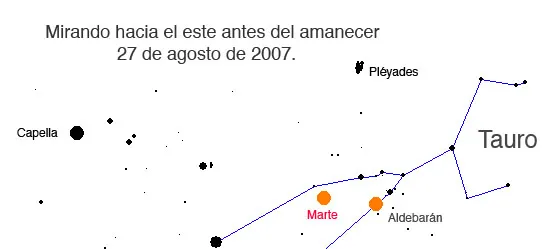
Not so fast. It's true there won't be two moons in the sky on August 27, but there will be two "eyes". At three in the morning, on that date, Mars will rise on the eastern horizon, along with the huge red star Aldebaran. The two red lights, located side by side, will look like two mysterious, unblinking eyes in the darkness. It's worth getting up very early to see them!
If you have been following the adventures of the Spirit and Opportunity rovers, you know that Mars is now going through a global dust storm. This rust-colored dust mixes with the air and dims the sunlight, causing serious problems for the two solar-powered rovers. Last month, the rovers had to remain "at rest" —unable to explore or dig and even unable to communicate with Earth occasionally— to conserve some energy. An amateur telescope pointed at Mars on August 27 might reveal vast dust clouds partially eclipsing some of its known surface markings. Or it might reveal a completely orange sphere —that's how Mars looks when a dust storm reaches such intensity. Keep watching; the view will improve each night.
You are now 1,600 kilometers closer to the planet Mars.
Sources and related links
Note on Ciencia@NASA