Scientists say they are one step closer to understanding the Sun's brightness. A monumental experiment buried beneath the mountains of Italy has provided physicists from Princeton with a clear understanding of the Sun's heart, and of a mysterious class of subatomic particles born there.
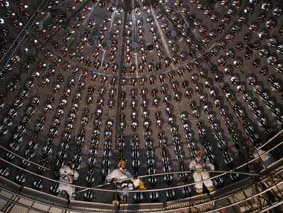
Interior of the stainless steel sphere during the installation of the photomultipliers. Credit LNGS
The researchers, working as part of an international collaboration on the Borexino experiment at the Gran Sasso underground laboratory in Italy, have made the first real-time observation of low-energy neutrinos, which are particles created by nuclear reactions generated in the core of the Sun.
"Our observations essentially confirm that we understand how the Sun shines," says Frank Calaprice, a researcher on the Princeton team.
The precise measurements of these neutrinos provide evidence for the theory about how these particles are produced.
In stars the size of our Sun, most of the energy is produced by a complex chain of nuclear reactions that convert hydrogen into helium. Starting with protons from hydrogen nuclei, the chain is one of several routes that end with the creation of helium nuclei and the production of sunlight.
Some steps in two of these routes require the presence of beryllium and physicists have theorized that these steps are responsible for the creation of 10 percent of solar neutrinos. But technological limitations have made the theory difficult to test, until now.
The Gran Sasso laboratory, located more than a kilometer below the surface, can overcome these limitations, allowing the team to observe low-energy neutrinos, which rarely interact with other forms of matter. Most particles that emerge from the Sun take so long to escape the interior that they change drastically before scientists can study them, so it has been difficult to prove how the Sun creates energy. Neutrinos are key because they escape before having time to change.
"These discoveries show that the scientific understanding of the chain of nuclear processes that make the Sun shine is essentially correct, at least up to the part of the chain that involves beryllium."
The results point toward other questions as well. The sensitive detector has confirmed theories about why previous experiments have found fewer solar neutrinos than expected at high energies, a problem that stems from the particles' rare ability to oscillate from one type to another while traveling through space. While the Sun only produces electron neutrinos, these can change into tau or muon neutrinos, which are more difficult to detect.
Observing lower-energy neutrinos can help understand other predicted effects of the oscillation.
The Borexino experiment team will publish its discoveries in an upcoming issue of Physics Letters B. The paper is titled: "First real time detection of 7Be solar neutrinos by Borexino".
Sources and related links
- Note on EurekAlert
- Note on Scientific Blogging