A group of daring and curious scientists often gather to fly into the heart of storms in a NASA aircraft.
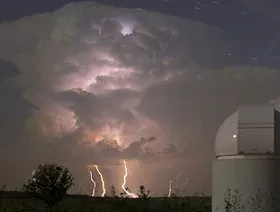
A storm near the Weikersheim Observatory, in southern Germany, in June 2007. Photo credit: Jens Hackmann. NASA
July 18, 2007: Shakespeare's King Lear cried out to the sky, begging it to pour all the fury of a storm upon him. A team of NASA scientists is asking for exactly the same thing: that some furious storms intercept them on their way—though, of course, not with the same malicious purpose as King Lear.
"We still have a lot to learn about storms and we would like to study them up close," says Michael Goodman, an atmospheric science expert working at the Marshall Space Flight Center. "We continue to accumulate evidence indicating that storms could be an important factor in climate change." But how? That is the question.
Seeking the answer to this question, this summer, a team of scientists (including Goodman), sponsored by NASA, is working in Costa Rica on a storm research campaign called TC4 or Tropical Composition, Cloud and Climate Coupling. Like King Lear, the TC4 mission scientists will exhort the sky to release its fury and, in this way, open the doors for them to be able to conduct the studies.
Some storms are so violent that the air they pump can reach a height of 60,000 feet above the Earth's surface, breaking through an atmospheric layer called the tropopause, until reaching the stratosphere: see diagram. The pilots of the TC4 research campaign will fly into and around the tropopause to discover what particles these storms throw out and also what the effect might be.
The team will also examine the icy cirrus clouds that form when storms reach the height of the tropopause. Like a blanket of light, these clouds spread over a vast area, reflecting sunlight and cooling the Earth's surface located beneath them. On the other hand, cirrus clouds also absorb infrared radiation coming from Earth. The fact of "trapping" infrared energy produces a warming effect. The particles driven upward by the force of the storms could cause changes in these icy clouds, thus disturbing the delicate balance between surface cooling and warming. What is the net effect this has on Earth's energy balance? We still don't know.
The TC4 campaign researchers have many tools at their disposal: several NASA satellites, three aircraft from that space agency (the ER-2, the WB-57, and the DC-8), weather radars, and sounding balloons. Each of these instruments plays a fundamental role in putting together the storm puzzle as they will collect data on lightning, water vapor, wind speed, infrared radiation emissions, dust particles, carbon monoxide, etc.
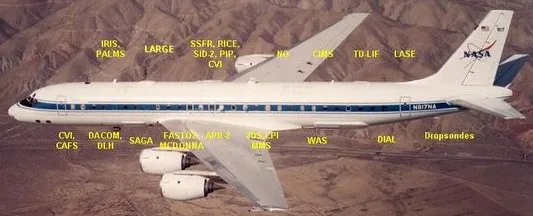
The DC-8 aircraft and the name of each of the scientific instruments it carries.
The most exciting instruments are the aircraft. NASA's DC-8 has seats for 35 researchers—well... if they traveled seated. Apparently these scientists walk around and talk to each other inside the plane, going from one end of the aircraft's aisle to the other.
What does it feel like to be among this crowd of curious scientists as the plane makes its way into the heart of a furious storm?
"When the plane flies over the storm, you can look out the windows, and all the scientists talk about the experiment—it's very exciting," says Robbie Hood, a researcher and experienced pilot at the Marshall Space Flight Center. "But on certain occasions, the only thing I've wished for was to sit at my desk because I wanted to see the radar or satellite images that were being generated at that moment."
If Hood flies on the DC-8 during one of the TC4 campaigns, her wishes will come true. What puts this experiment a step ahead of past climate research is a new instrument called the Real Time Mission Monitor (RTMM). Developed at the Marshall Space Flight Center, the RTMM collects data from all satellites and sensors, and displays a full-color image for the researchers on the plane to see. Scientists on Earth can also watch the live-generated images, while chatting with the scientists on the plane via instant messaging.
"I believe this instrument is going to stimulate people's imagination," says Hood. "When you observe live data, things look different from what you can observe two weeks later from a desk. And when you have so many scientists focused on something, in real time, it unleashes imagination, conversation, and collaboration. This will accelerate the way discoveries are made."
So these scientists will be generating a brainstorm inside a storm. "Spit, fire! Spout, rain!" let the thunder begin.
Sources and related links
Note on Ciencia@NASA