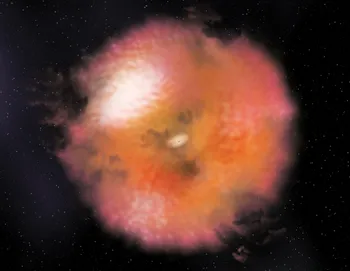
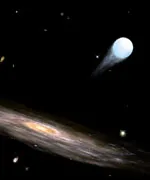
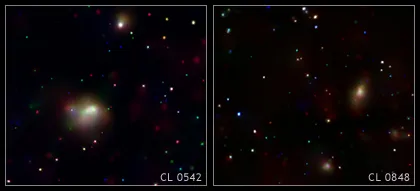
The event was designated GRB 070610 as it was discovered by the Swift satellite on June 10 of this year.
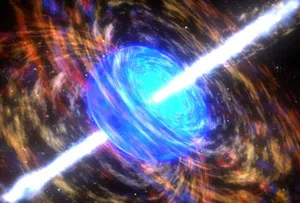
Illustration. Credit: NASA / SkyWorks Digital.
At first it seemed like another ordinary gamma-ray burst (GRB) in a distant galaxy. These bursts are thought to arise when massive stars collapse to form black holes.
But this GRB appears to have a completely different origin. Astronomers led by Mansi Kasliwal from Caltech traced the burst to a stellar system in our own galaxy, where a black hole and a star slightly less massive than the Sun are orbiting each other.
They suspect the black hole had an eruption while swallowing material stolen from its stellar companion.
This behavior has never been seen and scientists are not sure how to explain it.
Krzysztof Stanek from Ohio University, who is not part of the team, said this new type of event could be an exciting phenomenon to study, if more can be found.
"The reason we haven't seen something like this before is not because it's rare but because it's a low-energy event," explained the scientist, adding that this burst is intrinsically about 100 quintillion times less powerful than the long GRBs previously observed. "If the same thing happened in another galaxy, we don't have detectors sensitive enough to see it."
Sources and related links
- NewScientist:Nearby black hole caught burping gamma rays
- NASA's Swift satellite
- GRB070610 : A Curious Galactic Transient