Between September 15 and 19, Argentine astronomers gathered in Malargüe to share, discuss ideas, and present various research topics in their field. This meeting brought together national and foreign researchers. On this occasion, the organizers are the Institute of Astronomy and Space Physics (CONICET/UBA) and the Argentine Collaboration of the Pierre Auger Observatory.
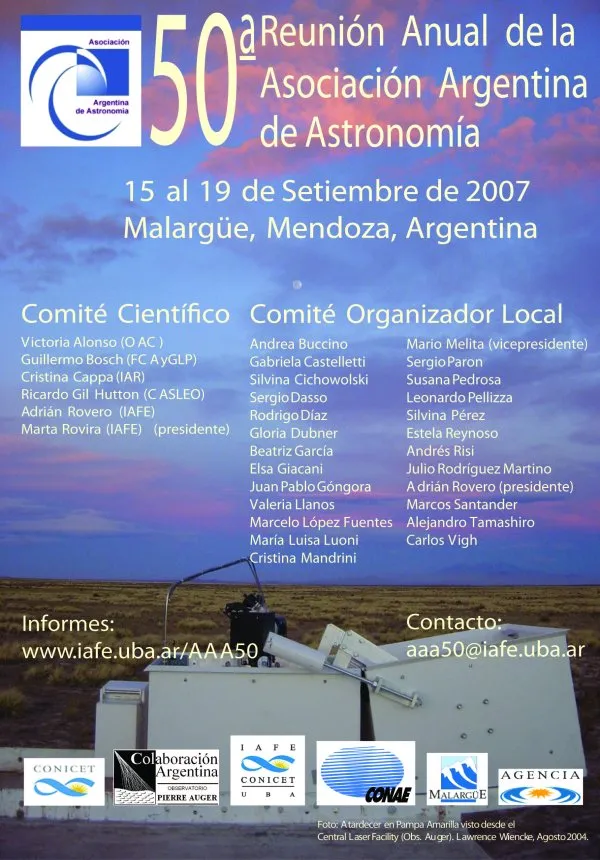
The 50th Meeting began this Saturday in the city of Malargüe, which welcomed participants covered in snow. Coming from different parts of the country, astronomers, physicists, and students converged at the "Thesaurus" Exhibition and Convention Center of the Malargüe Municipality.
During this Meeting, two public talks were organized; the first one was "Birth, Life, and Death of Massive Stars" by Dr. Nolan Walborn from the "Space Telescope Science Institute," and on Tuesday the 18th, the talk was "Astronomical Discoveries at the European Southern Observatory" offered by Dr. Félix Mirabel, from the European Southern Observatory.
With a visit to the Los Leones Fluorescence Detector of the Pierre Auger Observatory and a fellowship lunch, the Argentine astronomers concluded their annual meeting.
The 51st Meeting in 2008 will be organized by the Félix Aguilar Astronomical Observatory of the National University of San Juan.
A SPECIAL MEETING
This was stated by Dr. Gustavo Romero, President of the Argentine Association of Astronomy (AAA), at the start of the meeting. "It is special for several reasons, among them because the Association celebrates next year the fiftieth anniversary of its existence; another reason is because it is the first time it is held in the city of Malargüe where the Pierre Auger Observatory is located, the most important cosmic ray detector in the world and also the most important international collaboration in basic science in Argentina. In that sense, all astronomers have much to learn from this experience if we want to think about future international collaborations in observational aspects in our country. It is an interesting occasion for high-energy astrophysicists and the bulk of the astronomical community to come together to share ideas and plan future work."
Furthermore, Romero gave a brief overview of the situation since last year's astronomers' meeting. "The loss at the end of 2006 of Dr. Virpi Niemela, who was of great influence in Argentine astronomy; this year astronomy had to suffer, due to the lack of stable policies by the organizations that support science and technology regarding the payment of fees for the Gemini Observatory; that led to the suspension of assigned observing time and created a serious problem that is still ongoing."
Among the positive issues, Dr. Romero highlighted a recent meeting on theoretical astronomy, the results of which show that "it is in very good health."
Dr. Adrián Rovero, from the Institute of Astronomy and Space Physics (IAFE) and president of the Meeting's Organizing Committee, emphasized that "Malargüe is a city that has always welcomed us very warmly, all of us who come to work at the Auger Observatory; from the beginning, more than 10 years ago, we never imagined having a scientific meeting like this one, here in Malargüe."
He also thanked the staff of said Observatory, the sponsors, the National Council for Scientific and Technical Research (CONICET); the Agency for Scientific and Technological Promotion (ANPCyT); the National Commission on Space Activities (CONAE); the Argentine Association of Astronomy (AAA) and the Municipality of Malargüe.
Dr. Marta Rovira, researcher at the IAFE and president of the Scientific Committee of this meeting, also remembered the figure of Dr. Niemela, "we miss her not only professionally but also for her personal qualities. Argentine astronomy owes her a lot."
JOSÉ LUIS SÉRSIC AWARD
At the beginning of the aforementioned Meeting, Dr. Diego García Lambas received the José Luis Sérsic Award for established researcher. This award - given for the first time and which will be biennial - was awarded by the Argentine Association of Astronomy. García Lambas leads the Group for Theoretical and Experimental Astronomical Research (IATE) in Córdoba, an Institute dependent on CONICET; he also received the Enrique Gaviola Award given by the National Academy of Sciences. García Lambas has carried out important work in training human resources.
"I receive an award with the name of someone as special as Sérsic was, he had a phrase he often repeated: Deeds are love. He was the one who organized the first theoretical and experimental astronomy research group; he passed away 14 years ago, but the program he started was the basis for the current IATE Group. Receiving this Award is taking up the baton of his dream, which was for the Institute to be part of CONICET."
"Sérsic - commented García Lambas - was an extremely intelligent person, he had an extraordinary skill with calculations, he worked all the time. That teaching, that sharing with him, has been very important for me."
Asked about his work, Dr. García Lambas said that "I care a lot about working with people, the most valuable thing I have done is having found valuable people whom I have had the chance to help at moments in their careers, I did everything with them. I don't follow a single, defined thematic line, I research several topics that connect me with different people." In general, his topics focus on large-scale structure in the universe.
Dr. Sérsic was born in Bella Vista, Province of Corrientes, earned his doctorate in astronomy at the Faculty of Astronomical and Geophysical Sciences of the National University of La Plata, and soon moved to the University of Córdoba where he worked as a researcher heading the extragalactic astronomy group. He served as director of the Córdoba Observatory on two occasions. Sérsic was a member of several scientific institutions. In 1969, together with Dr. Jorge Sahade, he achieved the Creation of the IAFE. He also did great work in teaching and popularizing astronomy. Sérsic was one of the people who practically generated extragalactic astronomy research in Argentina.
Sources and related links
- Bulletin 224 (News from the La Plata Observatory), by Alejandra Sofía
- Images of the Meeting by Guillermo Sierra
- Meeting Site