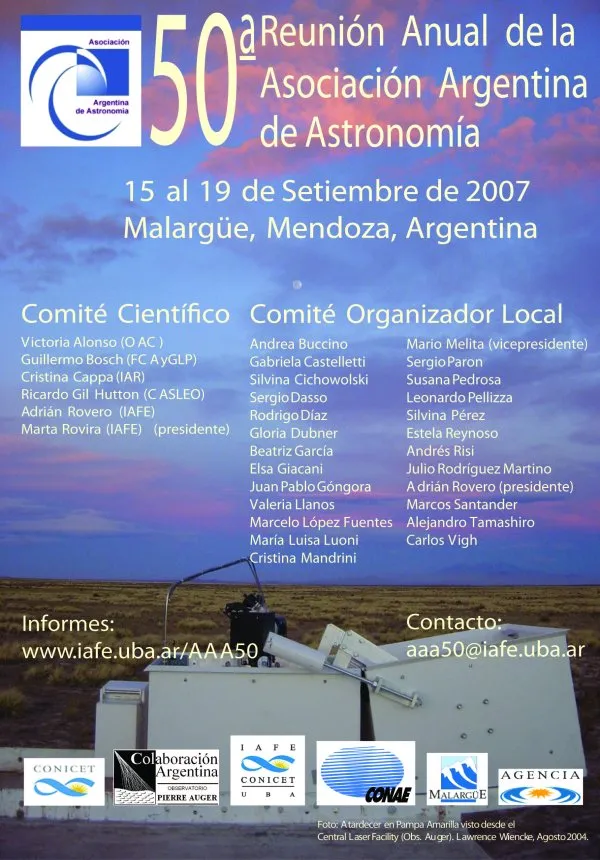
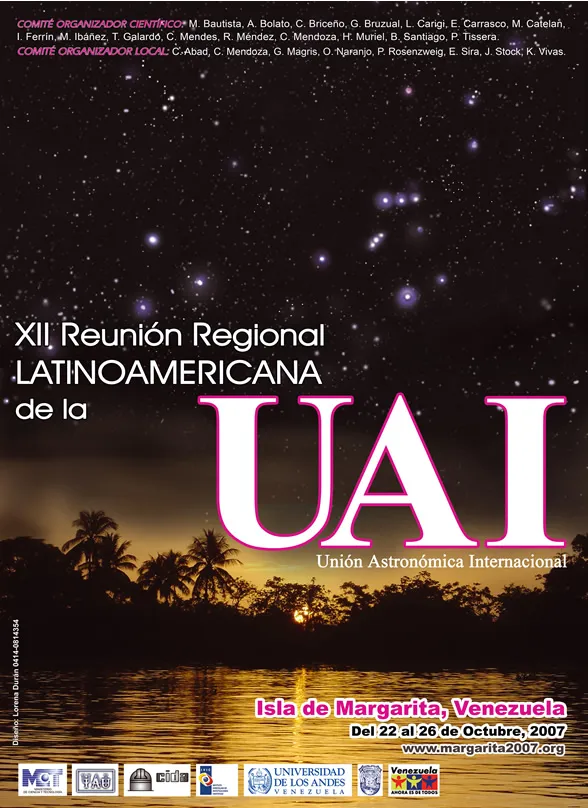
The last meeting of the Asociación Argentina de Astronomía was held in the Mendoza city of Malargüe. One of the talks for the general public was offered by Dr. Félix Mirabel, who serves as director at the European Southern Observatory (ESO)
The Malargüe community participated in two proposals for the general public during the past Annual Meeting of astronomers. All the proposals - papers, poster section, Assembly, talks - were held at the Malargüe Municipal Exhibition and Convention Center.
In the covered walkway leading to the Conference Hall, an exhibition about the Sun and its activity was hung.
See images at:
http://www.fcaglp.unlp.edu.ar/~extension/225/Centro/
The European Southern Observatory
Dr. Félix Mirabel fulfills several roles, among them ESO representative in Chile, scientific and executive director for Europe in the ALMA project in that country. He graduated as an astronomer from the Facultad de Ciencias Astronómicas y Geofísicas of the Universidad Nacional de La Plata and in Philosophy from the Universidad de Buenos Aires. He worked in England, the United States and France, is a Doctor Honoris Causa at the University of Barcelona, and has received the national science prize from the French Atomic Energy Commission.
See images at:
http://www.fcaglp.unlp.edu.ar/~extension/225/charla/
Data about ESO
It is a particular pleasure that Argentina is the host country for such an exciting project as the Auger project, aimed at solving one of the most important mysteries in astrophysics and physics. As for my activity, I have been in Chile for three years at ESO, whose full name is European Organisation for Astronomical Research in the Southern Hemisphere. This observatory has several sites, one in Santiago with its central offices; the La Silla Observatory, which is near La Serena, and the most modern one, Paranal, and the ALMA project.
ESO is a European organization for science and technology that is based in Germany and has been present in Chile since 1963 through a Treaty with the Chilean government. It is made up of 13 European countries, the last to join were Spain and the Czech Republic, and there are three more that are discussing joining the Observatory.
The mission of ESO -added Mirabel- is to investigate the skies of the southern hemisphere, develop frontier technological instruments, and serve the community of approximately 300 European astronomers. The La Silla Observatory was the first to be installed and is at 1,400 meters altitude; it has 13 optical telescopes, a radio telescope, and 4 in operation, two telescopes are of a 4-meter diameter.
Paranal is more modern, it is in the Antofagasta region in a very desert area and is the most advanced set of telescopes in the world. They are 4 telescopes of 8.2 meters in diameter and 4 auxiliary ones of almost 2 meters, on a platform with a surface area equivalent to a soccer field.
At 2,600 meters VISTA of 4 meters is installed, which will observe in infrared and will be within six months, while in the optical range it will begin to operate in the next two years.
Another major project is ALMA (Atacama Large Millimeter Array), an international astronomical facility. Its objective is to develop a telescope unparalleled in the world, composed of a group of up to 64 radio telescope antennas that will work together all pointing at the same source to study the Universe, from a site at 5,000 meters altitude on the altiplano (Llano de Chajnantor) of the Andes Mountains.
Adaptive optics, a success
One of the techniques developed at ESO is active optics, which is a procedure devised to correct the deformation of the mirrors. It is perhaps the most resounding success of ESO; this adaptive optics allows correcting what is caused by the turbulence generated by the atmosphere.
Mirabel detailed several of the most important scientific results of recent years, which included quasars and black holes. A triple asteroid system, which is a kind of mini planetary system, was discovered, for example; the most important of the three is called Sylvia, using the analogy with the mother of Romulus and Remus (that's what the other two asteroids are called). They are between Mars and Jupiter.
A few years ago, the study of exoplanets exploded worldwide, of which more than two hundred are known today. The direct image of one of those exoplanets was made at Paranal using adaptive optics.
One of the most important results is having confirmed, through the dynamics of the stars, the existence of a supermassive black hole at the dynamic center of our galaxy, through the "Very Large Telescope" at Paranal.
We have observed a cluster of massive stars around a supermassive black hole in our galaxy and the question is how massive stars can form in its vicinity, no less than a black hole of three million solar masses; there should be enormous tidal forces that would not allow the formation of stars.
This cluster must have formed in the vicinity of the extremely intense gravitational field that is produced by that amount of solar masses.
A few months ago, the discovery of the first triple quasar was reported; they are supermassive black holes in the nuclei of massive galaxies. They can be radio wave emitters, it is in a region of space that is smaller than the distance between our galaxy and the Magellanic Clouds.
Another discovery is a spiral galaxy in formation at a very early epoch of the universe.
The talk continued with more examples of the instrumental and scientific capabilities of ESO.
Sources and related links
- Site of the 50th Meeting of the AAA
- Newsletter of the La Plata Astronomical Observatory Year 6 - Number 225 By Alejandra Sofía