The Dawn spacecraft is on its way to Ceres and Vesta.
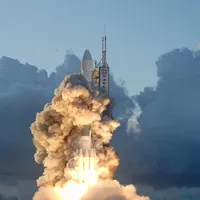
Launch of Dawn. NASA.
The launch was successful from Cape Canaveral and telemetry has already been obtained indicating that a correct orientation in space was achieved and that it was already generating solar energy.
Over the next 80 days, controllers will test and calibrate the systems and subsystems to ensure the spacecraft is ready for the journey ahead.
The 4.8-billion-kilometer odyssey includes the exploration of Vesta in 2011 and the small planet Ceres in 2015. These two icons of the asteroid belt have been privileged witnesses to the history of our solar system. The instruments will measure mineral composition, shape, topography and tectonic history.
The spacecraft uses an ion propulsion system, which uses electricity to ionize xenon to generate thrust. The ion thrusters generate less power than conventional engines but can maintain it for longer.
Sources and related links
- Article on NewScientist
- Article on UniverseToday
- Article on Barrapunto
- Article on SondasEspaciales
- Video on NationalGeographic
- Article on NASA/Dawn
- Video on YouTube