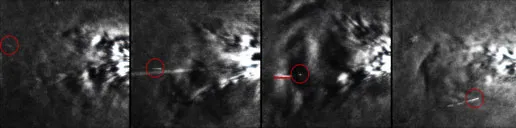
Discovering another comet is nothing new for the European Space Agency's Solar and Heliospheric Observatory (SOHO), as it has already located more than 1,350. However, SOHO's latest comet, discovered by the LASCO coronagraph, is a bit different, because SOHO had already 'discovered' it twice before.
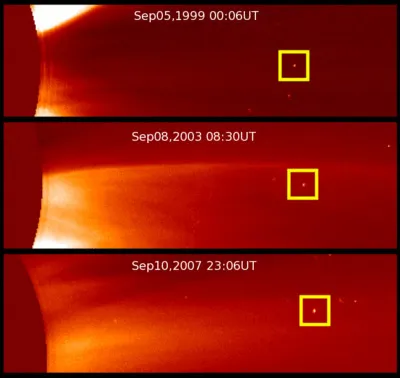
Images of SOHO's first official periodic comet. Courtesy of Karl Battams, NRL
For the first time during the mission, SOHO has discovered a somewhat infrequent phenomenon, a periodic comet (that is, one that returns every so often). Although many of the comets discovered by SOHO are believed to be periodic, this is the first one that has been recorded and officially declared as such.
Astronomers have seen thousands of comets, but only about 190 have been classified as periodic. Many more are proposed as periodic, but they only obtain official classification when they are seen describing their orbit around the Sun more than twice and have orbital periods of less than two hundred years. The most famous periodic comet is Halley, which returns to Earth every 76 years and whose last passage near the Sun was recorded in 1986.
SOHO's comet describes a much smaller orbit, as it takes about four years to go around the Sun. It was first observed in September 1999, and again in September 2003. In 2005, German doctoral student Sebastian Hoenig realized that the orbit of the two comets was so similar that they could actually be the same object. To prove his theory, he calculated a combined orbit for the comet, from which he deduced that it would return on September 11, 2007. Sebastian's prediction was absolutely accurate: the comet reappeared in SOHO's LASCO camera right on time, so it has received the official designation P/2007 R5 (SOHO).
It's strange, because the object doesn't exactly look like a comet. It does not have a visible tail or coma formed by dust and gas. At first, scientists wondered if it might be an asteroid, that is, a piece of space rock instead of a remnant of space ice. However, P/2007 R5 (SOHO) did show some of the characteristics of comets. As it passed 7.9 million kilometers from the Sun, about 5% of the Earth-Sun distance, they observed that its brightness increased by a factor of approximately one million. This is something common for a comet.
So P/2007 R5 (SOHO) seems to behave like a comet, even though it doesn't look like one. "Perhaps it is the nucleus of some extinct comet," speculates Karl Battams, head of SOHO's comet discovery program. Extinct comets are those that have expelled most of their volatile ice and no longer retain enough to form a tail or coma. There is a theory that they are common objects among the celestial bodies that orbit near the Sun.
Sources and related links
- Press release at ESA
- Note at BadAstronomy
- Note at SOHO
- Note at Newscientist
- Video on YouTube