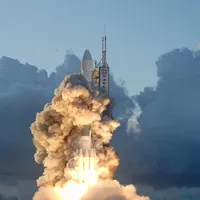
The unmanned Foton spacecraft, carrying a payload of more than 40 European experiments from ESA, successfully lifted off in the early hours of today. The Soyuz-U launcher took off from the Baikonur Cosmodrome in Kazakhstan at 13.00 CEST.
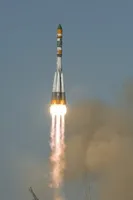
Liftoff of Foton-M3. ESA
Shortly after, the Russian Foton-M3 spacecraft separated from the rocket's upper stage and entered a 300 km orbit, from which it will circle the Earth once every 90 minutes.
The Foton spacecraft will spend 12 days in orbit, during which the experiments on board will be exposed to microgravity and, in some cases, to the harsh environment of outer space, before re-entering the atmosphere and landing in the steppes near the border between Russia and Kazakhstan.
The 400 kg European payload consists of experiments that will allow advances in many areas of knowledge. The scientific experiments come from a wide variety of scientific disciplines, such as fluid physics, biology, protein crystal growth, meteoritics, radiation dosimetry and exobiology (life outside Earth). The technological experiments could lead to more efficient oil extraction processes, better alloys for semiconductors and the development of more efficient thermal control systems.
One of the most striking European payloads is ESA/DLR's Aquahab experiment, an aquatic habitat that will be used to observe the effect of weightlessness on a single-celled organism, Euglena gracilis, and a dwarf cichlid fish.
The Biobox payload contains two programmable incubators with five cell biology experiments. Three of them will study the effect of weightlessness on bone-forming cells and on the cells responsible for bone degradation. A fourth experiment will allow the study of the harmful effects of space radiation on skin tissue, while another seeks to understand the effects of weightlessness on connective tissue cells.
Two more experiments are included in Eristo/Osteo, a joint project of ESA and the Canadian Space Agency. The two sets of identical devices contain four thermally controlled experiment trays that will be used to test and evaluate the effects of drugs and growth factors on bone cell activity.
The Franco-Belgian TEPLO experiment aims to measure the performance and characteristics of new heat pipe designs under weightless conditions. This type of technology will greatly help reduce the mass and complexity of thermal control subsystems used in space.
Attached to the exterior of the spacecraft is a multi-user experimental device called Biopan, designed to expose its ten experiments to the harsh space environment for the entire duration of the mission. On Foton's heat shield are mounted the Stone-6 and Lithopanspermia experiments, in which pieces of rock containing living organisms will be exposed to the extreme temperatures and pressures experienced during atmospheric re-entry.
In addition, an ambitious experiment known as the Young Engineers' Satellite 2 (YES2, Young Engineers' Satellite) will be carried out on the exterior of Foton. Under the direction of ESA's Education Office, some 450 students from ESA Member States and other countries have worked with prime contractor Delta-Utec on the design and construction of the 36 kg payload.
On September 25, the YES2 satellite will deploy a 30 km long tether, the longest ever deployed in space. A small atmospheric re-entry capsule, released from the end of the tether, will be used to demonstrate the possibility of recovering small payloads from Earth at a fraction of the cost of current methods.
Sources and related links
Note at ESA