A NASA satellite captured the first image of the collision between a comet and a solar hurricane. It is the first time scientists have witnessed such an event. The event was recorded on April 20 by one of the STEREO satellites.
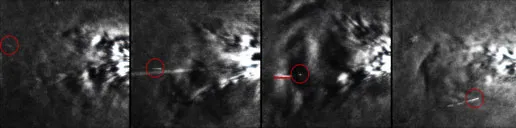
Images of the separation of Encke's tail. NASA
The phenomenon was caused by a coronal mass ejection. The collision resulted in the separation of the plasma tail of the comet Encke. Observations of the comet reveal the brightness of its tail as it is swept by the mass ejection and the subsequent separation. The researchers combined the images into a movie.
Comet Encke, a periodic comet like Halley, was traveling in Mercury's orbit.
Scientists at the Naval Research Laboratory made the observations using the Heliospheric Imager aboard the STEREO-A spacecraft. The results will be published in the October 10 edition of Astrophysical Journal Letters.
Coronal mass ejections are violent eruptions with masses greater than one billion tons. They travel from 60 to over 2000 miles per second. These "solar hurricanes" cause geomagnetic storms that can damage satellites, radio communications and power systems.
Preliminary analyses suggest that the disconnection of the tail could be triggered by what is known as magnetic reconnection, in which the opposing magnetic fields around the comet are brought together by the magnetic fields of the ejection. Thus, the comet's fields reconnect and release a burst of energy that separates the tail. A process similar to what happens with Earth's magnetosphere during a magnetic storm and that generates auroras.
Sources and related links
- Note at NASA
- Note at Science@NASA
- Note at Physorg