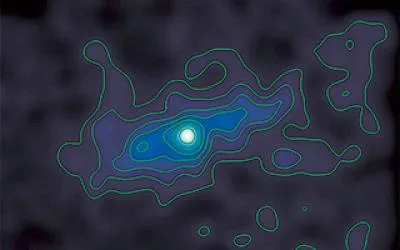
Often astronomical research seems to focus on the most distant and/or the faintest objects. But what about the part of the universe that is closest to us, in space and in time? What happens, for example, with the nearest galaxies?
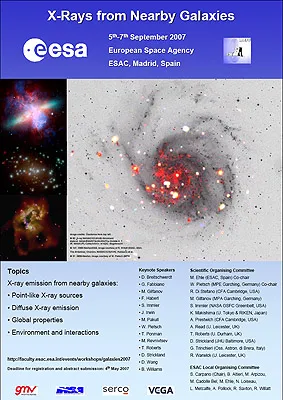
Poster for the Congress X-rays from Nearby Galaxies. ESA
To them, and to the data collected about them by space X-ray telescopes -like ESA's XMM-Newton- was dedicated a congress held last week at the European Space Astronomy Centre (ESAC), in Villafranca del Castillo (Madrid). Among other things, the existence of intermediate-mass black holes was discussed, a controversial hypothesis that is losing strength.
ESA's X-ray telescope, XMM-Newton, and its NASA equivalent, Chandra, have been in orbit for more than five years and have already produced a large amount of data on nearby galaxies. These studies are also very useful for better understanding the X-ray emission of our own galaxy, the Milky Way -the hardest to study precisely because we are inside it-, and that of more distant galaxies. "These observations allow us to compare, and thus give us a new approach to studying the evolution of galaxies," explains Matthias Ehle, a member of the XMM-Newton team and scientific organizer of the congress together with Wolfgang Pietsch, from the Max Planck Institute in Garching, Germany.
At the congress "X-rays from Nearby Galaxies" (ESAC, September 5-7) the most recent results in this field were reviewed, as well as the main problems to be solved. One of these problems is to discover what some exceptionally bright X-ray sources are –called Ultraluminous X-ray Sources, ULXs in its acronym– that are observed in nearby galaxies. "One hypothesis is that they are intermediate-mass black holes, black holes of a few thousand solar masses (compared to the billions of solar masses of the black holes that occupy the center of galaxies, or the also common stellar-mass black holes). At the congress, very solid alternative explanations were presented, such as that ULXs are normal black holes, of stellar masses, in binary systems that are simply going through a very active stage."
Another important problem is to find out what types of objects, and in what proportion, are contributing to the total X-ray luminosity of galaxies, and also the evolution of these components in relation to the galaxies that host them.
And another much-debated issue has to do with an old problem in X-ray astronomy: the origin of the diffuse X-ray emission in the disks and halos of galaxies. How much of this emission is due to specific sources and how much to hot interstellar gas (which is at millions of degrees of temperature)? According to Mike Revnivtsev, from the Max Planck Institute in Garching (Germany) and IKI in Russia, the emission from specific sources is the most important.
The congress also aimed to "stimulate new ideas" on how to use the X-ray telescopes that exist today to address these problems, explained Stefania Carpano, a member of the organizing committee and a researcher at ESAC. How the next generation of space X-ray missions should be was also discussed.
Sources and related links
- ESA press release
- Astroseti:X-ray signal shows presence of elusive black hole