New research shows that the Magellanic Clouds are recent visitors to this neighborhood and not gravitationally bound satellites as previously thought.
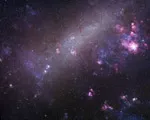
The Large Magellanic Cloud. Credit: Robert Gendler and Josch Hambsch
The Large Magellanic Cloud (LMC) and the Small Magellanic Cloud (SMC) are two of the Milky Way's closest neighbors. An incredible sight in the southern hemisphere, they were named after Ferdinand Magellan explored this area in the 16th century. For hundreds of years, these galaxies were considered satellites of our Galaxy, gravitationally bound to the Milky Way. New research by Gurtina Besla (from the Harvard-Smithsonian Center for Astrophysics, CfA) and her colleagues shows that the Magellanic Clouds are recent visitors to this neighborhood.
Although they look like bright clouds to the naked eye, the Magellanic Clouds are both irregular galaxies. The LMC is located about 160,000 light-years from Earth. It is much smaller than our Galaxy (one twentieth the size) and has one tenth of the stars housed in the Milky Way. The SMC is 200,000 light-years away, about 10 times smaller than its companion and about 100 times smaller than the Galaxy we inhabit.
Earlier this year, CfA astronomers reported having measured the velocities of these nearby galaxies with the greatest precision to date. The velocities turned out to be abnormally high. Two explanations were proposed: 1) The Milky Way is more massive than previously thought, or 2) The Magellanic Clouds are not gravitationally bound to our Galaxy. Subsequent analyses by Besla and her colleagues verified the second explanation. The parabolic orbit they calculated for the Clouds, based on the observed velocities, shows that both are on their first passage by the Milky Way.
The results carry serious implications. For example, as a spiral galaxy, the Milky Way has a large disk of gas mixed with billions of stars.
This disk is known to be significantly warped, extending about 10,000 light-years above and below the galactic plane. Astronomers theorize that gravitational tugs due to previous passages of the Clouds caused that warp or distortion. However, if the Clouds arrived only between 1 and 3 billion years ago, they are probably not the cause of that warp.
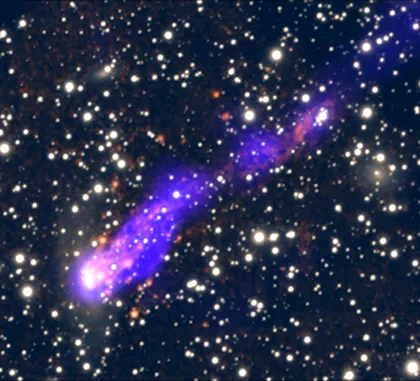
Another issue is related to the Clouds themselves. A long trail of hydrogen gas called the Magellanic Stream, which extends behind the Clouds, spanning 100 degrees in the sky. Some astronomers suggested that this stream formed from the gravitational interaction of the Clouds with the Milky Way.
Finally, the star formation history of the Clouds will have to be revised. Instead of continuous star formation, as in our Galaxy, the Clouds go through periods of very intense formation (starbursts) followed by periods of great calm. It was thought that these "starbursts" coincided with previous passages by our Galaxy. Given these new studies, that explanation would not be valid, although it is possible that the cause is the interaction between the Clouds themselves.
The paper describing the work has been accepted for publication in Astrophysical Journal.
Paper: Are the Magellanic Clouds on their First Passage about the Milky Way?, Besla et al.
Sources and related links
- CfA press release
- Note in NewScientist